


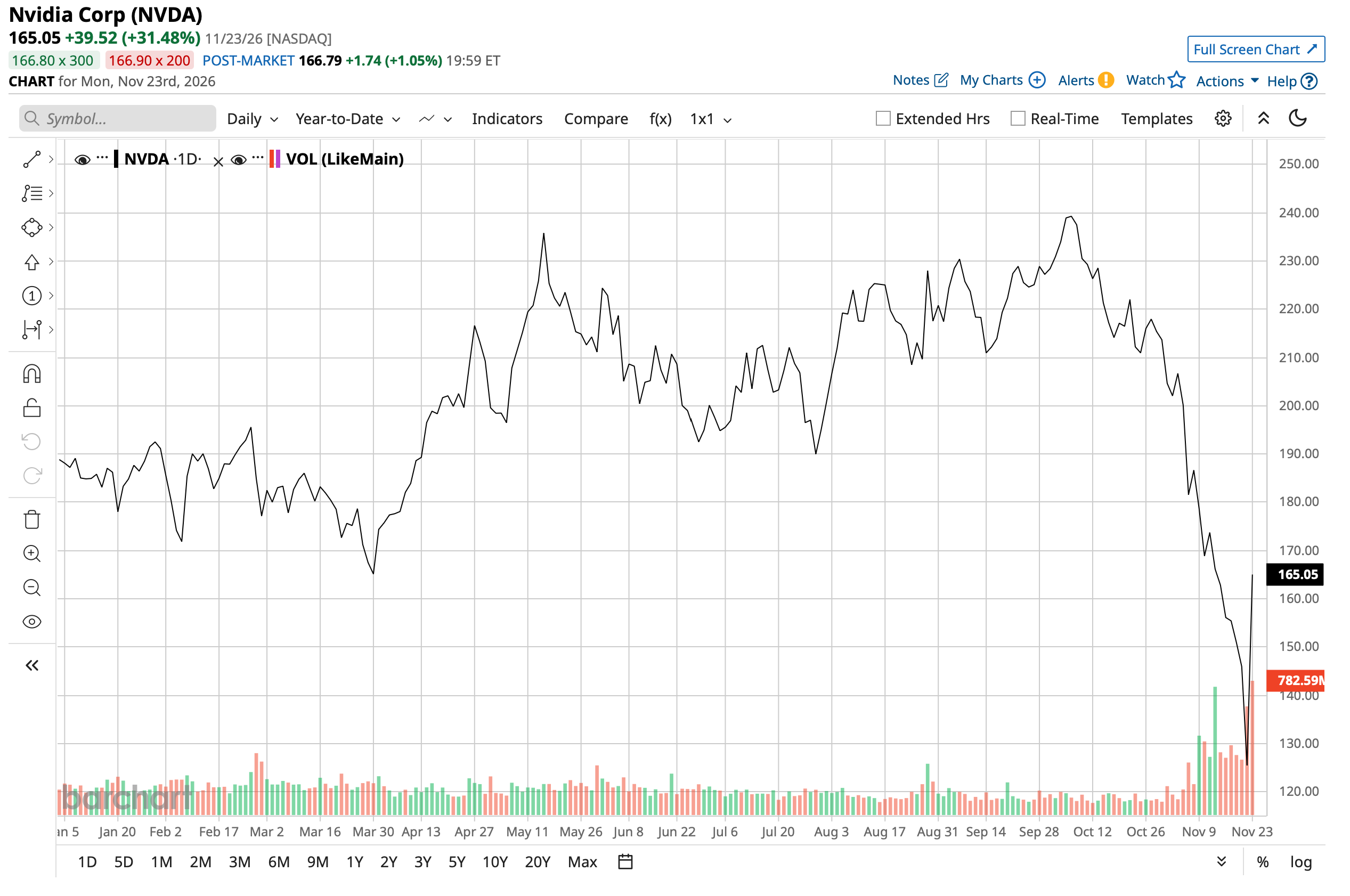
Once upon a time, Nvidia (NVDA) was the most valuable company in the world. It was also the first company to ever reach a $5 trillion market capitalization. Thus, when the company was hit with CEO Jensen Huang's resignation earlier this month over an affair with an alleged Chinese spy, things reached a low point for NVDA stock, which was already well off from its all-time highs seen in October.
In fact, the loss in market cap value was so acute from those highs that it was reportedly equivalent to more than 8% of the country's GDP. So important was Huang to Nvidia, the broader artificial intelligence (AI) trade, and consequently the U.S. economy that President Donald Trump himself intervened to turbocharge his return as Nvidia's CEO this week — within less than two weeks of his resignation.
The U.S. government has reportedly found no wrongdoing on Huang's part and concluded that he had not acted in a manner inimical to the interests of the United States. In fact, Trump said that U.S. Attorney General Todd Blanche confirmed the government "does not possess evidence that he has engaged in any unlawful conduct.”
Unsurprisingly, investors cheered the news, with NVDA stock ending the day up a massive 31% on Nov. 23. That marked the stock's best showing in a single trading session in more than two decades. The S&P 500 ($SPX) also popped 4.7% on Nov. 23, yet NVDA stock is still down nearly 17% on a year-to-date (YTD) basis.
So, what does Jensen Huang bring to Nvidia that caused trillions of dollars in market cap value to evaporate from the company? And what makes Nvidia so crucial to the U.S. economy? Let's take a closer look.
AI Will Drive a U.S. Economy Powered By an Nvidia Engine
In terms of raw numbers, Nvidia's current market cap of about $3 trillion is roughly 9% of the U.S. economy. Moreover, on its latest earnings call, Nvidia revealed that it had increased its purchase commitments to $390 billion from $279 billion in the second quarter of fiscal 2027, representing sequential growth of about 40%. Increasing purchase commitments conveys that the company is confident demand for its GPUs remains strong.
As of the Nov. 23 close, Nvidia's market cap was also 6.12% of the S&P 500's total market cap, demonstrating the company's sheer might. Moreover, Nvidia is one of the most widely held stocks among exchange-traded funds (ETFs), index funds, mutual funds, retirement accounts, and pension funds. Notably, major U.S. institutional investors Blackrock (BLK), Vanguard Capital Management, and State Street (STT) alone hold more than 4.51 billion shares of Nvidia.
Finally, Nvidia reported in August that its partners are building manufacturing capacity across 43 states, and that it “plans to produce up to $500 billion of AI infrastructure in the U.S.” with its partners. The initiative includes semiconductor manufacturing, electronics manufacturing, and AI-system production. Notably, Nvidia cited a Public First estimate that Nvidia-attributable U.S. AI infrastructure activity could contribute about $485 billion to U.S. GDP in 2026 and support more than 100,000 jobs.
Clearly, for the United States, Nvidia's importance lies not only in its ability to compete with China in AI but its substantial economic value for the U.S. and its citizens through its operations.
Nvidia's Pristine Financials
Nvidia once again posted a clean double beat and issued guidance exceeding expectations in Q3 fiscal 2027. CFO Colette Kress also raised the firm’s revenue growth forecast for fiscal 2028 to 75% from 70%.
Revenue came in at $115.8 billion, a 103% year-over-year (YOY) advance. Within that, data-center sales jumped 110% YOY to $107.6 billion, helped by a $20 billion contribution from Vera Rubin. The company called Vera Rubin its fastest product ramp ever. Meanwhile, Nvidia also announced a decision to stop licensed Hopper GPU sales to China, with its Q4 sales outlook of $130 billion containing no China Hopper revenue.
Gross margin was 74.9% versus 73.5% a year ago. Net income climbed 109% YOY to $64.9 billion. Likewise, non-GAAP diluted EPS rose to $2.68 from $1.27 a year earlier, clearing the consensus mark of $2.47 per share.
Cash generation also demonstrated a strong trajectory. Net cash from operating activities rose to $48.3 billion from $23.8 billion a year earlier. Nvidia closed the period holding $29.1 billion in cash and carrying no short-term debt.
From a valuation standpoint, NVDA stock appears to be reasonably priced. For example, the forward price-to-earnings (P/E) multiple of 13 times is below the sector median of 18.8 times.
What Do Analysts Think of NVDA Stock?
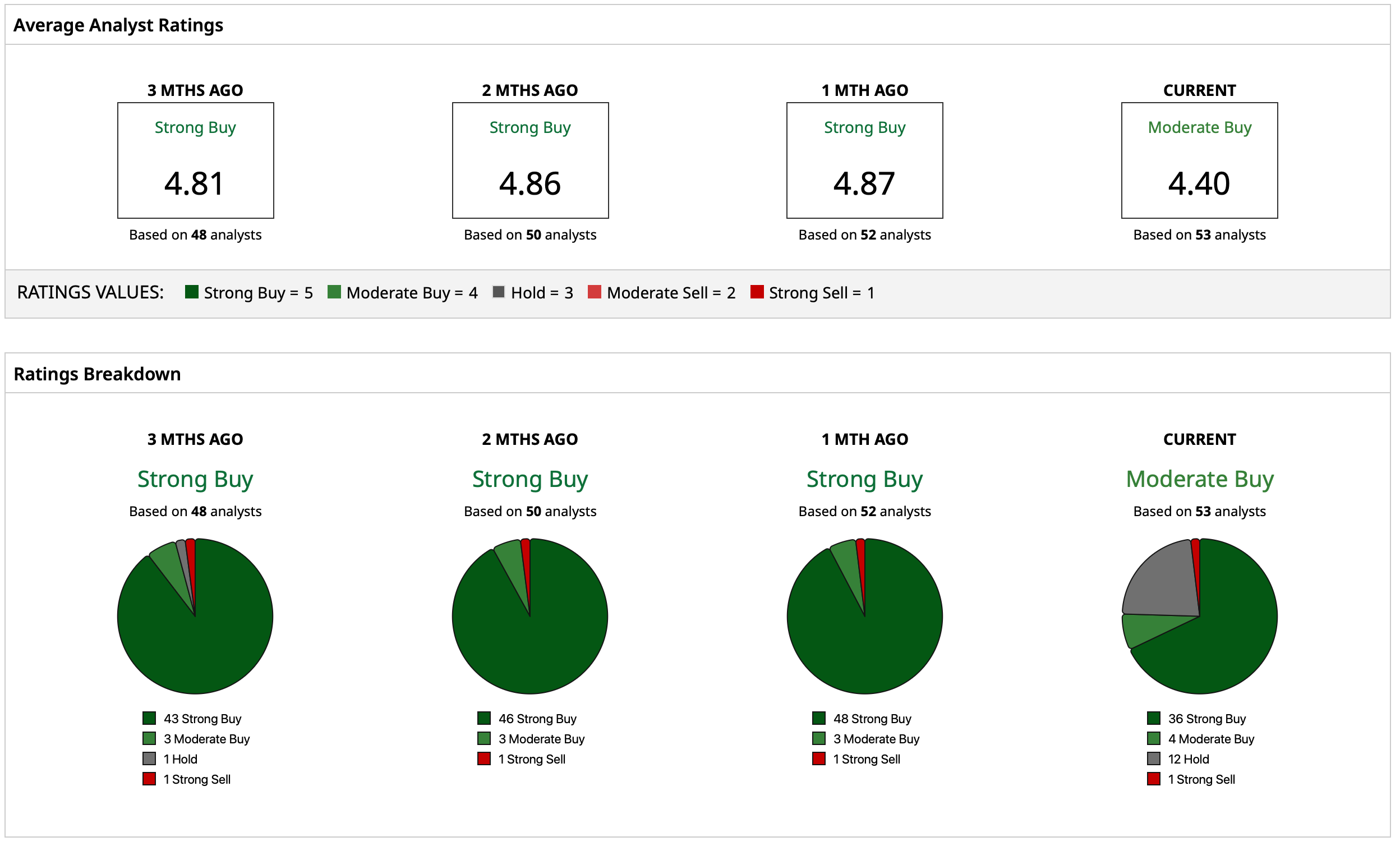
Overall, analysts have a consensus “Strong Buy” rating for Nvidia stock. Out of 53 analysts covering NVDA stock, 40 have a “Strong Buy” rating, four have a “Moderate Buy” rating, eight analysts have a “Hold” rating, and one analyst has a “Strong Sell.” The mean target price of $243.21 indicates potential upside of 57% from current levels, while the Street-high price target of $425 suggests a possible 174% climb from here.
On the date of publication, Pathikrit Bose had a position in: NVDA . All information and data in this article is solely for informational purposes. For more information please view the Barchart Disclosure Policy here.