


The Zhitong Finance App learned that as Wall Street resumed trading after the Thanksgiving holiday, the US stock market experienced a strong rebound on Friday, but Bitcoin failed to follow the rise of US stocks; instead, it once again fell below the 60,000 US dollar mark. Investor confidence continues to be affected by factors such as recent major cryptocurrency hacking incidents and heightened regulatory policy uncertainty after the US midterm elections. Bitcoin's cumulative decline in November reached about 23%, which is likely to be the biggest monthly decline in more than four years.
Bitcoin rose 2.3% earlier on Friday to break through $62,000, but then the trend reversed, falling to a 24-hour low of about 58,760 US dollars when US stocks opened, and then traded around 59,900 US dollars. Meanwhile, the S&P 500 is up 1.6%, while other cryptocurrencies are generally lower.
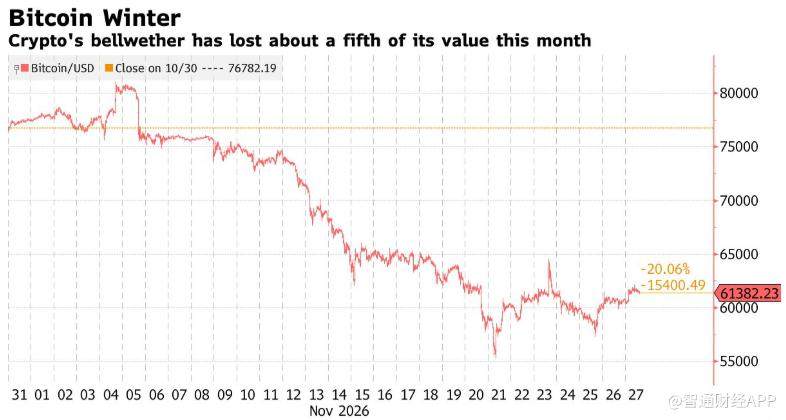
It is worth noting that Bitcoin followed the rise of US stock index futures earlier in the day, but after the official opening of the US stock market, it was once again under selling pressure, which clearly diverged from the trend of US stocks. Alex Kuptsikevich, chief market analyst at FxPro, said: “If the price of Bitcoin falls to $57,000, it will mean that the market returns to a short-term bearish pattern.”
Big Bitcoin account book profits have shrunk drastically
The recent continuous decline in the cryptocurrency market has led to a sharp decline in the book profits of large Bitcoin holders, making it closer and closer to ending the year in a state of loss.
According to a report released by blockchain data analysis agency CryptoQuant on Friday, the average unrealized profit margin for wallets holding 1,000 to 10,000 bitcoins fell to 5.7% this quarter, the lowest level since 2026, a sharp drop from 33.9% at the end of September.
Looking at the overall scale, the total unrealized profit of wallet addresses holding at least 1,000 bitcoins is currently only US$23.8 billion, far lower than the US$124.7 billion in September of this year, and a decrease of about 92% from the peak of US$294.4 billion set in August 2025. This means that as the price of Bitcoin continues to fall, most of the book profits previously accumulated by large holders have been eroded, and some investors are gradually approaching the break-even point.
Meanwhile, as the year-end holiday season approaches, the decline in market liquidity may further amplify cryptocurrency price fluctuations. Fredrick Collins, founder and CEO of the cryptocurrency data platform Velo Data, said, “We are entering the holiday season. Market trading may be light for the rest of the year, and price fluctuations may be severe.”
In a context where investor confidence has yet to clearly recover, regulatory policy uncertainty persists, and large holders' book profits continue to shrink, whether Bitcoin can once again stabilize the $60,000 mark will be the focus of short-term market attention.