

American Depository Receipts

American Depository Receipts (ADRs) are negotiable certificates issued by an American depository bank that represents a specified number of shares in a non-US company (usually 1 share).
They offer a way for investors to purchase stock in listed overseas companies that would otherwise not be available. This can be beneficial for the foreign firm as ADRs allow traders to invest in their company by reducing costs involved with listing on various Exchanges.
· Key Things to Note
- An ADR is a certificate issued by a US bank that represents shares in a foreign stock.
- These certificates trade on US stock exchanges.
- ADRs and their dividends are priced in USD.
- They aim to represent an easy and liquid way for US investors to own foreign stocks.
- These investments may open investors up to extra fees and taxation.
ADR Fees
Investing in ADRs usually incurs additional fees that are not charged for local securities. The depository bank or regulatory Custodian that holds the underlying security may charge a fee (known as a custody fee) to cover the cost of creating and issuing the ADR.
Some ADRs may also charge a cancellation fee in the event of ADRs delisting or being cancelled. This fee may not be specifically mentioned, so the person purchasing an ADR should refer to the prospectus of the respective ADR they are buying to confirm the fee.
The table below is an example only of a summary of ADR fees that may be charged by ADR Custodians. Specific amounts, payment frequency, and timing can call vary depending on the ADR.
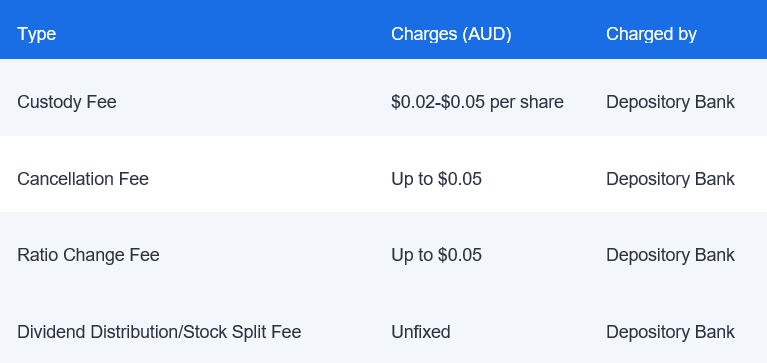
The list of ADR fees is also available on the Webull website: www.webull.com.au/pricing.
Are ADR Fees charged by Webull?
Webull itself does not charge any ADR fees as Webull is not a Depository Bank and as such is not an ADR Custodian. However, Webull must pass on any relevant ADR fees received by its US Custodian (namely Apex Corporation) to the relevant ADR Custodian where applicable.
ADR Taxes
Holders of ADRs realise any dividends and capital gains in USD, however, dividend payments are net of currency conversion expenses and foreign taxes (usually the bank will automatically withhold the necessary amount).
Where Can I Find Additional Information on ADR Fees?
Most ADRs fall under the custody of four key banks – BNY Mellon, Deutsche Bank, Citi Bank, and J.P. Morgan. If you are unable to find the relevant information on the primarily listed bank’s website, you can try the websites of the other three:
- BNYM: DR Directory (adrbnymellon.com)
- Deutsche: Deutsche Bank - Depositary Receipts (db.com)
- Citi: Citi's Depositary Receipt Services (factsetdigitalsolutions.com)
- JPM: J.P. Morgan's adr.com | The premier site for the global investor
Webull also works closely with Apex Clearing Corporation as Webull’s custodian for ADR issuance and fees. It is recommended that clients research ADR custodians and follow up on the latest announcements of the company to ensure they know what fees may apply.
Additional information can be found on Apex’s website: https://www.apexclearing.com/home-2/

All Comments