

Three Common Mistakes in Single Options Trading
There are many risks involved with trading out-of-the-money options, options with short expiration dates, and trading without a plan. Understand the importance of picking a strategy that works for you, and why you should stick to that plan and not let your emotions get the best of you.
#1 Over-investing in speculative OTM options
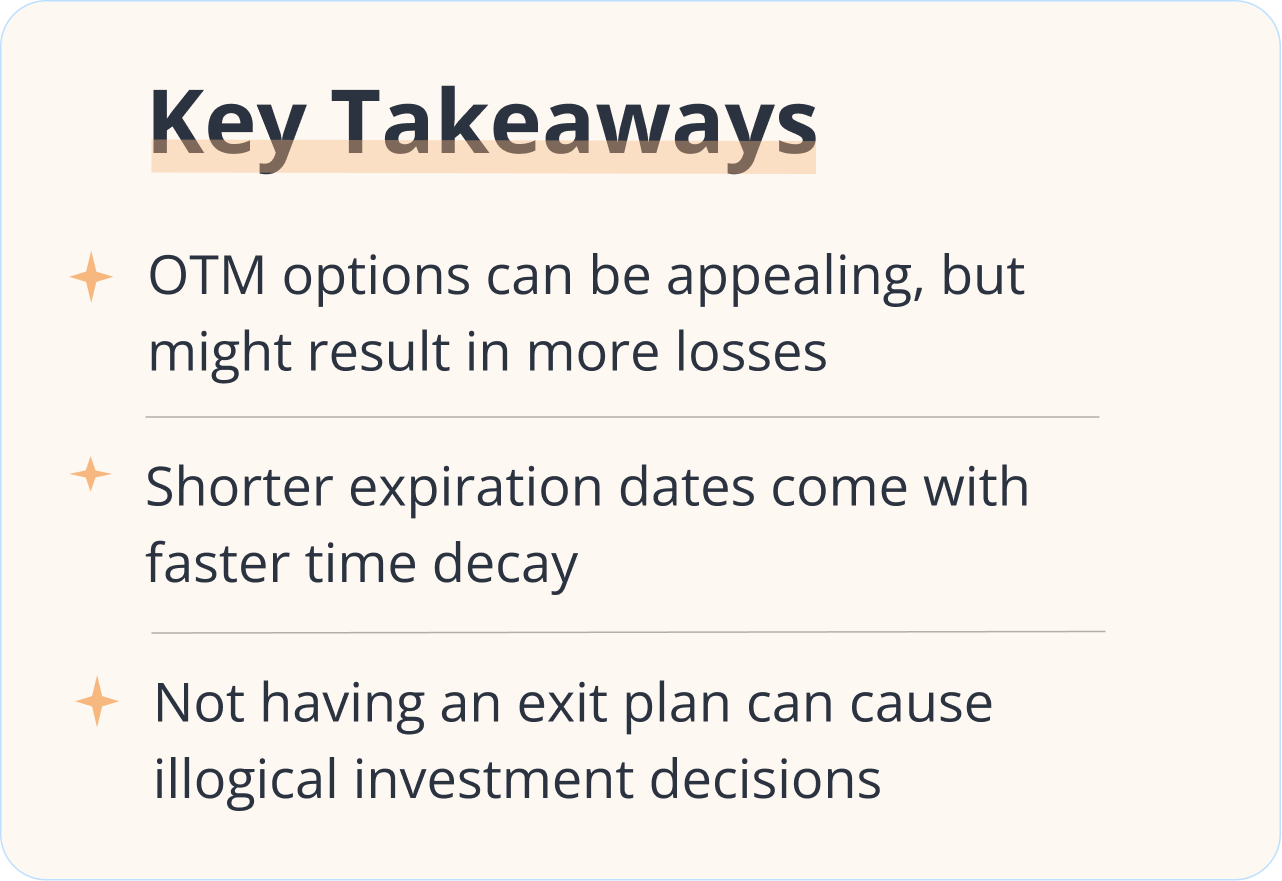
OTM options can seem appealing to new traders since they cost less than options that are ATM or ITM. The cheap cost of an OTM option seems ideal if you’re trying to follow the strategy of buying low and selling high. When buying an OTM call option, you’re hoping for it to move into the money, letting you buy the stock at a discount that exceeds the premium you paid. Sometimes this strategy works, but it’s difficult to consistently succeed if you’re always betting on your out-of-the-money positions to move into the money. Focusing only on buying OTM options is likely to cause more loss than profit.
Under the right circumstance, a buy write strategy can help investors achieve the same goals, but with a more conservative risk profile. Imagine that instead of buying the OTM option, you simply buy the long stock position at market price, and sell that same option against it. Your option is collateralized (covered) by the long stock position in your account. You effectively reduce the amount you paid for the stock by collecting a premium, instead of giving up the premium to buy the option for a chance of getting the stock. This only works when the option remains OTM and expires without being exercised, but when it works, it achieves the same goal as buying OTM call options. And most importantly, it keeps the investor on the safer side of the exercise risk.
Of course, no strategy is entirely without risk. In the event that your short OTM option moves ITM and gets exercised, you still come out ahead for having collected the premium, but you miss out on the opportunity to profit from future gains. You also retain the downside risk of the stock. If the stock price declines by a greater amount than the premium you received, you’ll have a net loss on the position.
#2 Ignoring faster time decay when approaching expiration
When buying an option, it is crucial to consider the effect of time decay on how profitable your position is. When choosing an expiration date, you should factor in how long you think you need to hold the position for your strategy to play out. Time decay plays a major role in this analysis. The value of an option decreases as the expiration nears, as every passing day leaves less time for the position to turn profitable.
Options with less time until expiration have a cheaper premium, as the time value of the options has diminished. When buying these options, you are risking not having enough time for your strategy to play out and turn a profit. Time decay is always a factor in options trading, as time value is always a factor in option pricing.
#3 Not having or executing your exit plan
A good exit plan has an upside exit point and a downside exit point. The upside exit point is the price at which you’ll close a position while you are still profiting, rather than continuing to risk your accrued gains. A downside exit point is the price at which you’ll close a position, accepting your losses rather than trying to hold on for the chance of an upturn. Deciding on acceptable profit and loss levels ahead of time helps reduce your risk, because you don’t have to analyze and decide what to do while simultaneously monitoring an active position.
Sticking to your exit plan can help you get more consistent results from your trading. Rather than trying to maximize your profit on every trade, focus on establishing a successful trading pattern. It can be tempting to divert from your plan in hopes of a better outcome, but remember the goals you are trying to achieve and why you created the plan in the first place. Sticking to a plan is the best way to prevent your emotions or fears from controlling the outcomes of your investments.
Summary
If you’re new to trading options, there are many concepts and strategies that seem deceptively simple, straightforward, or easy to profit from. But no position is without risks, and everything comes with a tradeoff. When you divert from your plans in hopes of reaching huge profits, you often also risk huge losses. Developing a strategy that is consistent with your investing goals, the amount of risk you are comfortable assuming, and how long you’re willing to hold a position—and sticking to that strategy—is the foundation of options trading success.