

Warrant Pricing

Factors affecting the pricing of trading warrants are also relevant to the valuation of instalments, however the pricing of instalments must take into account additional variables such as dividend flows to the instalment holder.
The market value of a warrant can be divided into intrinsic value and time value.
Intrinsic value
A warrant's intrinsic value is based on the difference between its exercise price and the current price of the underlying asset.
A call warrant has intrinsic value if the asset price is above the exercise price. A put warrant has intrinsic value if the asset price is below the exercise price.
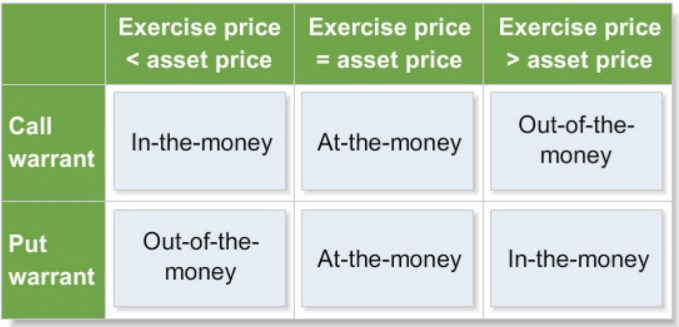
A warrant with intrinsic value is 'in the money'. A warrant that is 'at the money' or 'out of the money' has no intrinsic value.
A warrant will invariably trade at no less than its intrinsic value.
Time value
Time value is the remainder of the warrant's price above any intrinsic value.
When a warrant is at-the-money or out-of-the-money it has no intrinsic value, and the entire price is therefore made up of time value. An in-the-money warrant has both intrinsic and time value.
For example, assume XYZ shares are trading at $20.50, and a call warrant with a $20.00 exercise price is trading at $0.80.
The intrinsic value of this warrant is $0.50 (the share price of $20.50 less the strike price of $20.00). The remaining $0.30 is the warrant's time value.
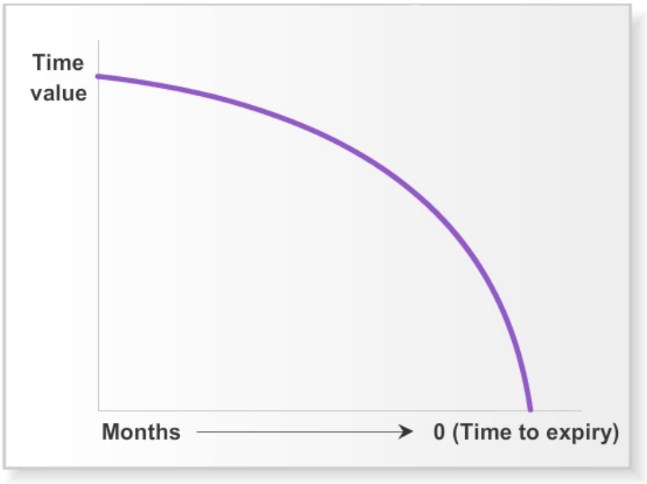
Time value declines over time in the process referred to as time decay. At expiry, the time value of the warrant is zero.
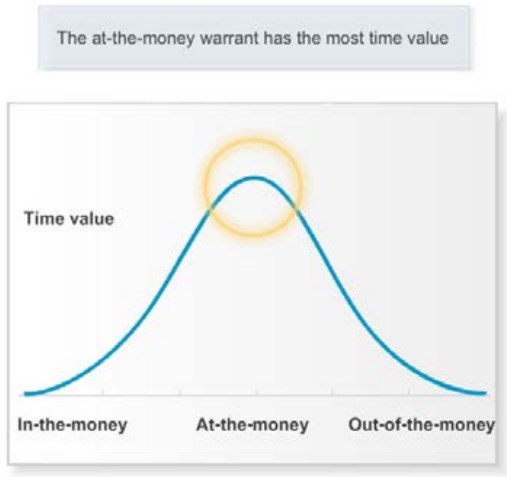
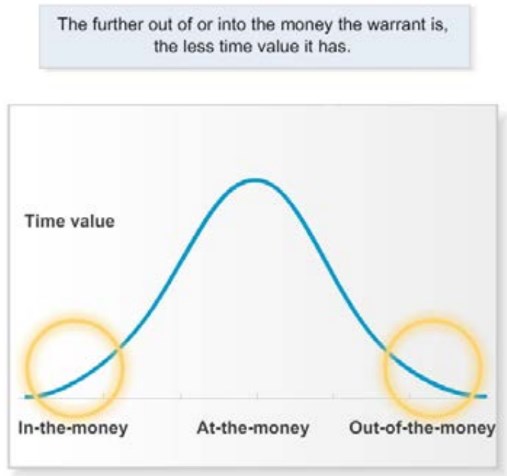
Not all warrants with the same time to expiry have the same amount of time value. The at-the-money warrant has the most time value, and the further the strike price is from the current stock price, the less time value the warrant has.
Time value is affected by several variables.
Time to expiry
All else being equal, the greater the time to expiry, the higher the time value of the warrant. As the buyer of a warrant, you want to see as large as possible a movement in the price of the underlying before expiry. The longer there is until expiry, the greater the possibility for such a movement and therefore the more you will be prepared to pay for the warrant.
As time passes, time value decreases. Time decay is not constant, but accelerates as expiry approaches. As a rule of thumb, a warrant loses around one third of its time value during the first half of its remaining life, and two thirds during the second half of its life.
It is essential to understand that time decay always works against the warrant holder, and that a warrant is a wasting asset with a limited life.
Volatility
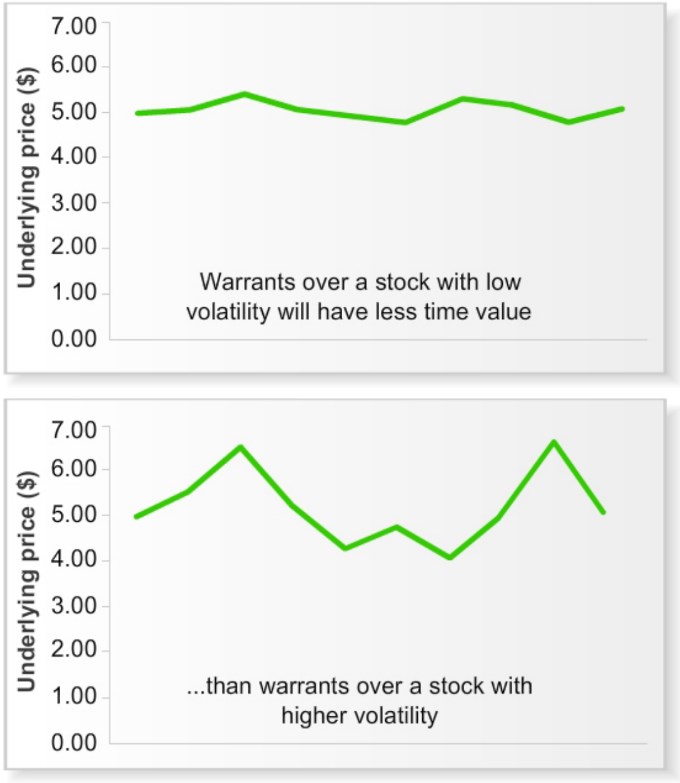
The more volatile the underlying asset, the higher the price of the warrant will be, all else being equal.
Volatility refers to the way the price of the underlying asset behaves, specifically the size and frequency of price movements. If the price tends to move rapidly over a wide range, the asset is more volatile than an asset that usually shows less rapid movements over a narrower range.
Volatility varies widely among stocks traded on ASX. Historically, stocks, such as the major banks, have tended to trade with relatively low volatility, while others, such as many of the resource stocks, have tended to trade with relatively high volatility. Volatility can also vary significantly over time, both for individual stocks, and for the market as a whole.
Higher volatility leads to higher prices for both call and put warrants. The more volatile a stock is, the greater the chance of a big movement in the stock price - and the larger your potential profits and losses.
Interest rates
An increase in interest rates will lead to more expensive call warrants and cheaper put warrants, all else being equal.
This is due to the funding cost/benefit built into the warrant position.
By buying a call warrant you can defer paying for the underlying until the warrant's expiry date and invest the funds elsewhere during this period. The higher interest rates are, the more interest you can earn, and the more the call warrant is worth to you.
The effect of an interest rate rise is the opposite for puts, as you are deferring the receipt, rather than the expenditure of funds.

Dividends
If the underlying stock goes ex-dividend during the warrant's life, the price of a call will be lower, and the price of a put higher, than if no dividend was payable.
This is due to the fall in the stock price that usually occurs on the ex-dividend date. The impact of dividend payments on instalments is different, as the holder usually receives the dividends paid.
Delta
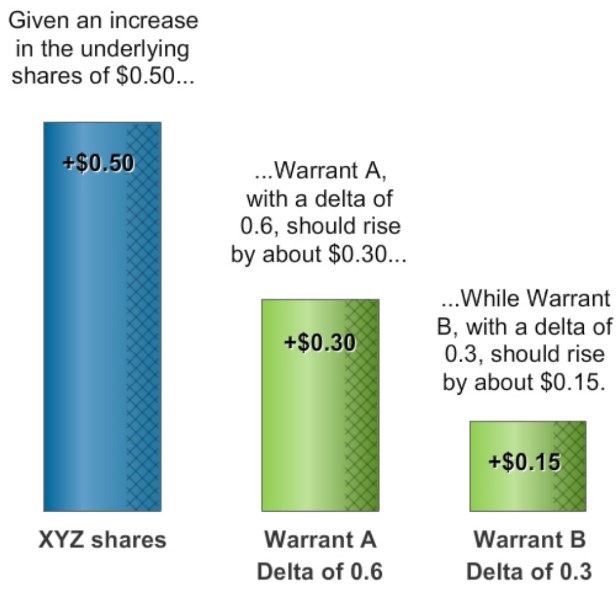
Delta is a measure of how a warrant's price should change given a certain change in the price of the underlying.
A warrant's delta is between 0 and 1.
Call deltas are positive, indicating that the warrant's price moves in the same direction as the price of the underlying. Put deltas are negative, indicating that the warrant's price moves in the opposite direction to the price of the underlying.
At-the-money warrants usually have a delta of around 0.5, or 50%. A warrant's delta increases, the deeper into the money the warrant is, and decreases, the further out of the money the warrant is.
For example, if a call warrant has a delta of 0.7, or 70%, and the price of the underlying shares rises by $0.10, you would expect the price of the warrant to rise by $0.07.
If a put warrant has a delta of -0.3, and the price of the underlying shares rises by $0.10, you would expect the price of the warrant to fall by $0.03.
Information contributed by ASX. To see the full course on Warrants go to: https://www.asx.com.au/investors/investment-tools-and-resources/online-courses/warrants-course

All Comments