

How Leveraged ETFs Manage Their Exposure in Active Markets?

The use of leverage offers magnification of exposure and returns, both positive and inverse, which increases the level of volatility associated with leveraged and inverse ETFs. For example, if the Russell 1000® Index increases by 1% in a single day, the Bull 3X ETF that tracks that index is designed to return approximately 3% on that same day (minus fees and expenses). Conversely, if the same index is down 1% in a day, that same fund should decrease by approximately 3% (minus fees and expenses).
Again, each leveraged ETF seeks daily exposure, which is a multiple of each fund's net assets. Daily market fluctuations cause net asset levels to rise or fall, which results in portfolio adjustments to help ensure that exposure levels for the following day are set at the correct multiple.
The fund company rebalances exposure daily by buying or selling securities, swaps or futures to ensure that each fund's total daily exposure is two or three times (depending on the fund's objectives) the net assets. This will allow the fund to track as closely as possible to its multiple of the benchmark index's daily performance.
In the following, we will review the details of the following scenario examples:
Bull Fund Examples
• 3X Bull Fund when the index rises
• 3X Bull Fund when the index declines
Bear Fund Examples
• 3X Bear Fund when the index rises
• 3X Bear Fund when the index declines
Scenario #1: Hypothetical Impact of a 1% Index Gain on a Daily 3X Bull Fund
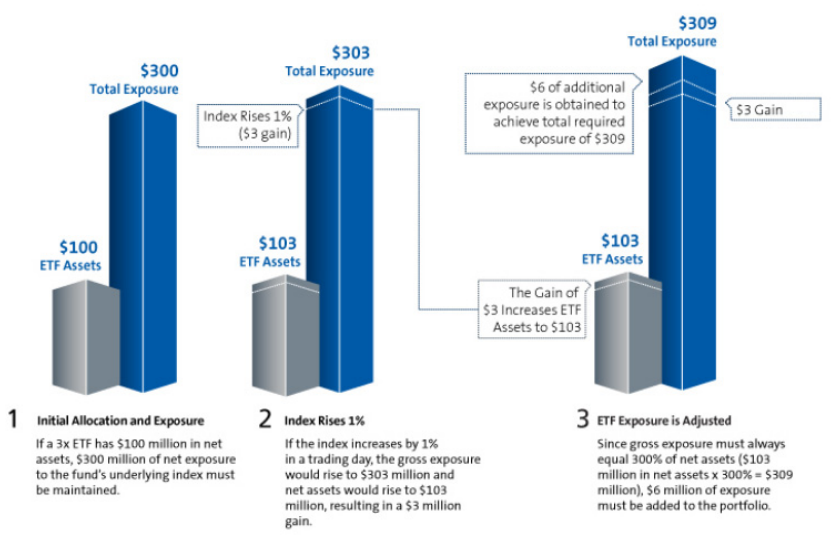
When the underlying index rises, the assets of the Bull Fund rise, so the fund must buy more exposure to the index so that the fund's total exposure is equal to 300% of the fund's new level of net assets.
Scenario #2: Hypothetical Impact of a 1% Index Decline on a Daily 3X Bull Fund
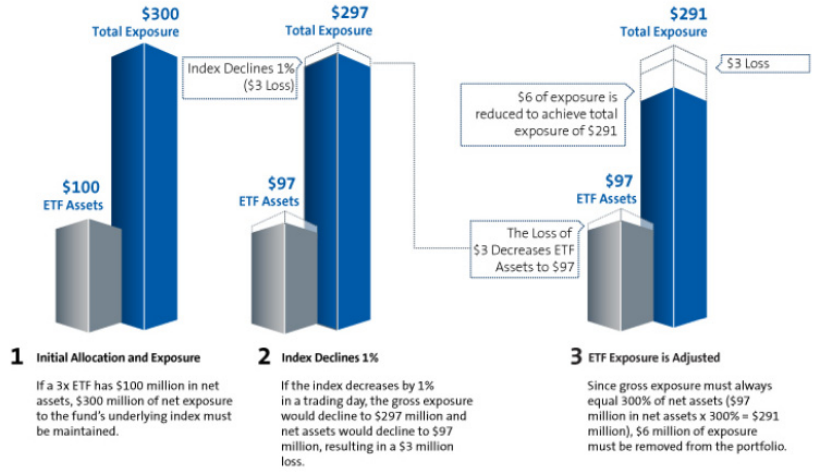
Let's examine what happens in the same 3X Bull Fund when the underlying benchmark index declines. When the underlying index declines, the assets of the fund also decline, so the fund must reduce its exposure to the index so that the fund's total exposure is once again equal to 300% of the fund's new level of net assets.
Scenario #3: Hypothetical Impact of a 1% Index Gain on a Daily 3X Bear Fund
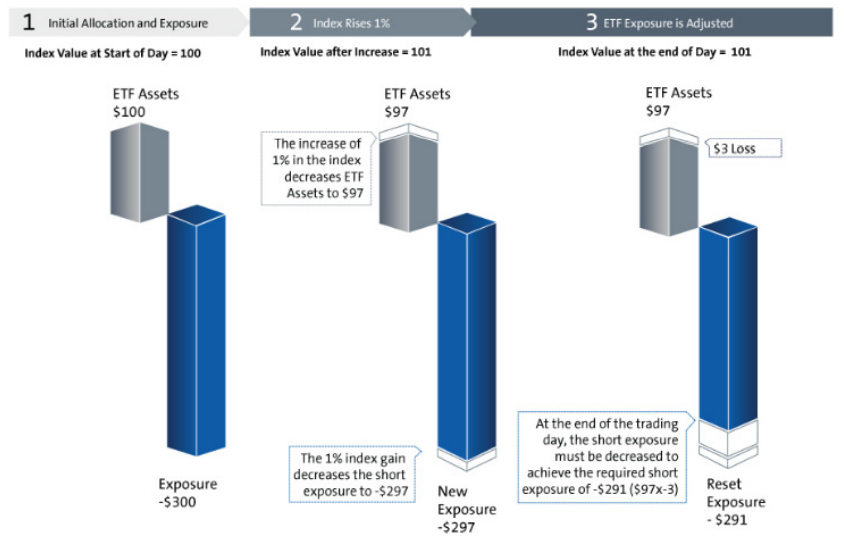
When the underlying index rises, the Bear Fund will experience a decline in net assets. As a result, the short exposure must be reduced in order to maintain the fund's daily investment goal of -300% exposure to its benchmark.
Scenario #4: Hypothetical Impact of a 1% Index Decline on a Daily 3X Bear Fund
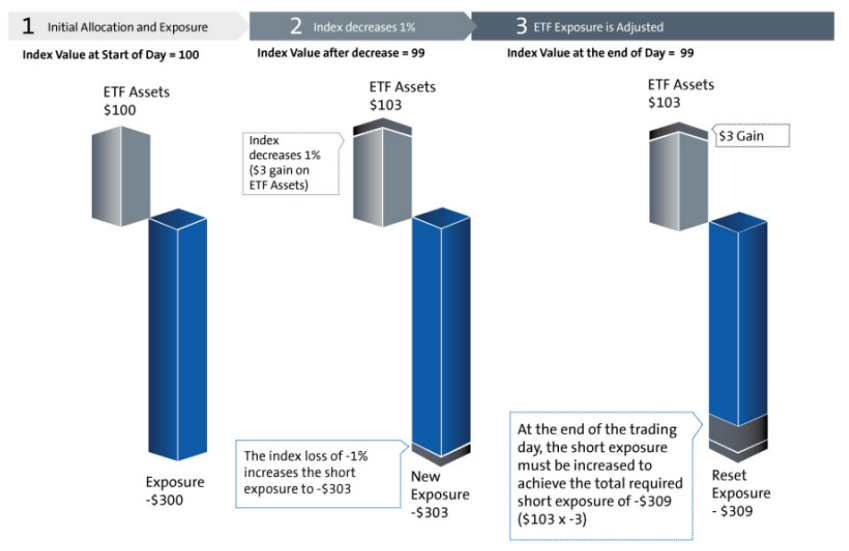
When the underlying index decreases, the Bear Fund will experience an increase in net assets. As a result, the short exposure must be increased in order to maintain the fund's daily investment goal of -300% exposure to its benchmark.
*These performance numbers do not reflect daily operating expenses and financing charges and are hypothetical in nature. There is no guarantee the funds will achieve their objective.

All Comments