

Market, limit, or stop order?
Market orders fill immediately but do not provide control over the filling price. Limit orders allow setting a preferred filling price but execution is not guaranteed. Stop orders trade at a specific level, but can be filled at a higher price once triggered and turned into a market order.
Market, limit, and stop orders are the three most commonly used order types. Each of them has its own distinctive features.
A market order is an order to buy or sell a stock at the best available price. It has the best chance of filling, but the filling price is not certain. A limit order is an order to trade a security at a specified price or better. It guarantees the filling price, but it is not guaranteed to be filled. A stop order, also called a stop-loss order, is an order to trade a security when it has reached above or below a specified price. It is triggered at the stop price and filled as a market order.
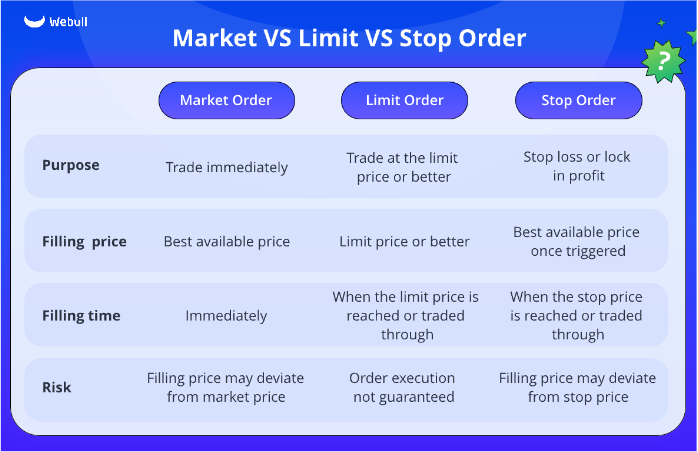
To sum up:
- Market orders work best for investors who want their orders to fill immediately and do not intend to control the filling price.
- Limit orders allow investors to set a price they wish to fill at. However, the execution of the order is not guaranteed, since it is not known where the stock price will go.
- Stop orders allow investors to trade until the stock price reaches a specific level. However, once the order is triggered and turns into a market order, the order can be filled at a much higher price than anticipated.
0
0
0
All investments involve risk, and not all risks are suitable for every investor. The value of securities may fluctuate and as a result, investors may lose more than their original investment. The past performance of a security, or financial product does not guarantee future results or returns. Keep in mind that while diversification may help spread risk it does not assure a profit, or protect against loss, in a down market. There is always the potential of losing money when you invest in securities, or other financial products. Investors should consider their investment objectives and risks carefully before investing.