

Risks of Warrants

Counterparty risk
Since a warrant is a contract between the issuer and the warrant holder, investors are exposed to the risk that the issuer will not perform its contractual obligations under the warrant. The ASX does not guarantee that the warrant issuer will perform its contractual obligations to you.
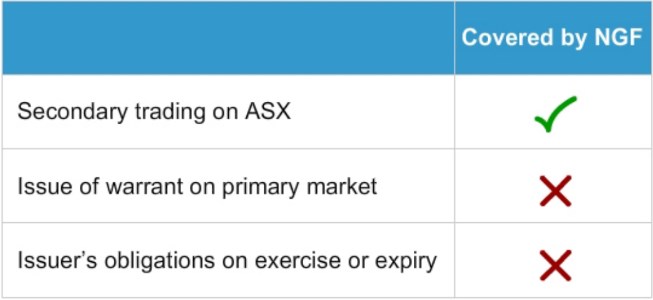
The National Guarantee Fund (NGF) covers the secondary trading of warrants on ITS, but not the issue of a warrant on the primary market, nor the settlement obligations of the issuer arising from exercise or expiry.
The stringent criteria an institution must meet to be accepted as a warrant issuer is designed to minimise the credit risk of dealing with the issuer. To date, no warrant issuer on ASX has defaulted on its obligations to settle upon exercise of a warrant.
To help you evaluate the ability of the issuer to meet its obligations, the warrant's disclosure document contains information on the financial situation of the issuer. An issuer may also be rated by a credit rating agency such as Moody's or Standard & Poor's.
Performance of the underlying asset
The success of an investment in a warrant depends above all else on the performance of the underlying asset during the instalment’s life
In the case of a warrant that gives you the right to buy the underlying asset (such as an instalment, or an equity call warrant), if the value of the underlying does not rise, you will not make a profit on your investment.
In the case of a warrant that gives you the right to sell the underlying asset (such as an equity put warrant), you will not make money on the warrant unless the price of the underlying asset falls.
In both cases, even if the price of the underlying shares stays steady, you will lose money on the warrant due to time decay.
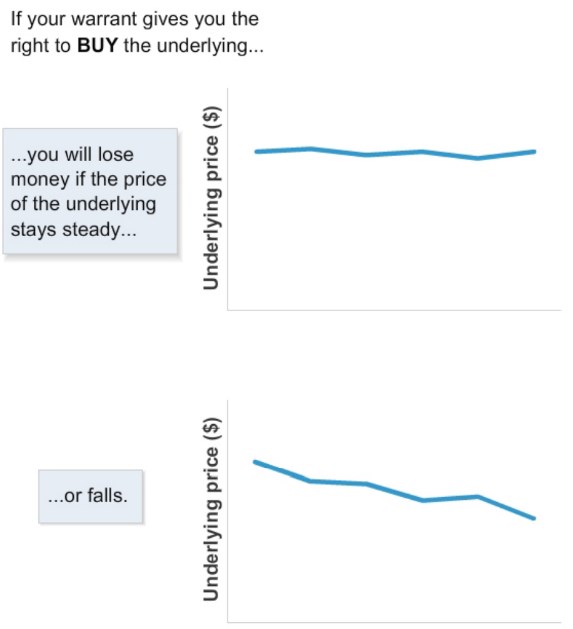
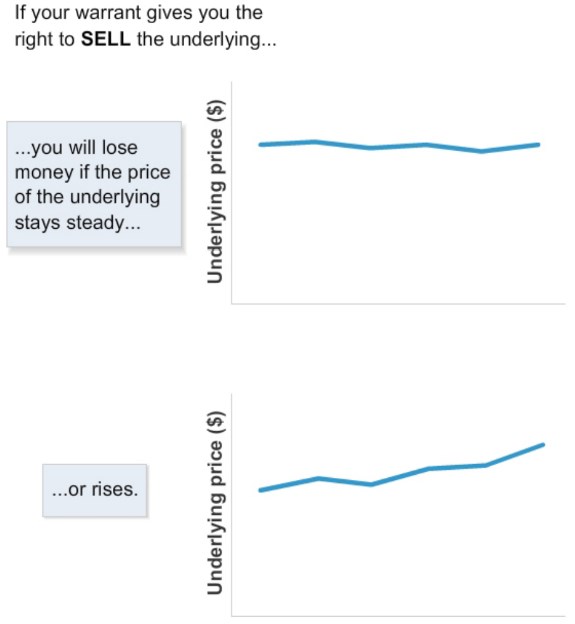
The risk of an unfavourable movement in the price of the underlying asset is also referred to as 'market risk'.
Leveraged losses
Market risk of course also applies to an investment in shares - a loss will result if the share price moves unfavourably.
However, the leverage that almost all warrants offer magnifies losses in percentage terms. The more highly geared the warrant is, the more damaging this effect.
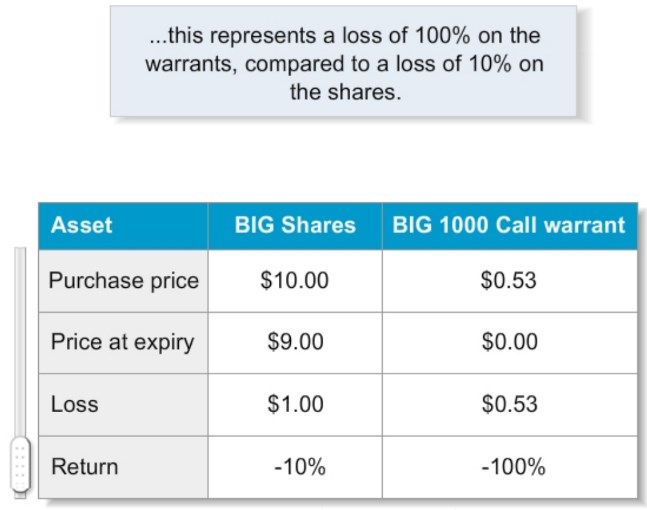
For a given movement in the price of the underlying asset, you get a larger movement, in percentage terms, in the price of the warrant. So, if you have bought a call warrant, and the price of the underlying shares falls, your percentage losses from the warrant will be greater than if you held the share itself.
For example, the table opposite compares an investment in BIG shares at $10.00 with the purchase of call warrants over BIG shares with an exercise price of $10.00.
A 10% fall in the value of shares by expiry of the warrant results in a loss of 100% on the investment in warrants.
Liquidity risk
Liquidity risk is the risk that you may be unable to sell your warrants for a reasonable price in the market. There may be insufficient orders to buy the warrants, or the price being offered may be too low. Sometimes a lack of liquidity in a warrant series may be due to a lack of liquidity in the underlying shares.
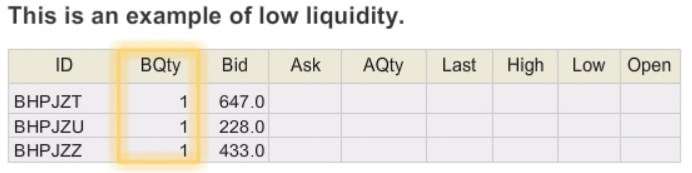
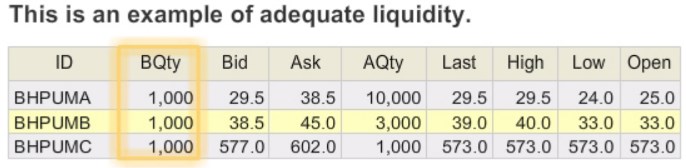
Under ASX Operating Rules, issuers have certain obligations that are intended to promote a liquid market. Issuers generally meet these obligations by making markets in their warrants.
However, in times of extreme volatility, the ability of market makers to maintain a market may be put under stress. The presence of suitable quotes in the market at such times cannot be assured.
Currency risk
Some warrants, for example currency warrants, may be denominated in a foreign currency.
An investment in such warrants exposes you to the risk of an unfavourable movement in the exchange rate of the relevant currency against the Australian dollar.
Early termination
In certain circumstances, an issuer may terminate a warrant before the expiry date.
Issuers often reserve the right to nominate certain extraordinary events which may result in the early expiry of a warrant series. The warrant's disclosure document will set out the types of events which may be nominated as extraordinary, and the consequences of an extraordinary event occurring.
Examples of extraordinary events include:
- the suspension of trading in the underlying security
- the delisting of the underlying company
- a takeover of the underlying company.
Possible consequences of an extraordinary event occurring include:
- the warrant's expiry date may be brought forward,
- the exercise price may be adjusted, or
- the warrant may lapse with a payment to the holder.
Information contributed by ASX. To see the full course on Warrants go to: https://www.asx.com.au/investors/investment-tools-and-resources/online-courses/warrants-course

All Comments