


- In early February 2026, Vishay Intertechnology reported fourth-quarter 2025 sales of US$800.92 million with a return to modest profitability, issued first-quarter 2026 revenue guidance of US$800 million to US$830 million, launched new power inductors and sulfur‑resistant chip resistors, and its board later declared a US$0.10 per-share dividend payable on March 26, 2026.
- Together, the stronger quarterly results, robust order commentary across most product lines, and continued product innovation in automotive, industrial, and AI-related applications suggest Vishay is actively aligning its portfolio with areas of higher and more resilient end-market demand.
- Next, we’ll examine how Vishay’s return to profitability and strong order trends may influence its longer-term investment narrative.
Uncover the next big thing with 28 elite penny stocks that balance risk and reward.
Vishay Intertechnology Investment Narrative Recap
To own Vishay Intertechnology, you need to believe its broad exposure to automotive, industrial, and AI‑related hardware can eventually support healthier margins on today’s heavy capacity investments. The key short term catalyst is whether recent order strength translates into sustained, profitable utilization of new capacity, while the biggest risk remains ongoing negative or weak free cash flow against rising capex and borrowing needs. The latest quarter’s modest return to profitability helps, but does not remove this risk.
Among the recent announcements, the new RCA‑SR e3 sulfur resistant chip resistor series looks particularly relevant. It deepens Vishay’s offering in automotive and industrial environments where reliability is critical and design cycles tend to be longer, tying directly into the current order strength commentary. If these kinds of products win more sockets in vehicles, smart grid projects, and AI power systems, they could support better factory loading when recent capacity investments come fully on line.
Yet, behind these encouraging product wins, investors should also be aware of the risk that heavy capacity spending could leave Vishay with underutilized assets if...
Read the full narrative on Vishay Intertechnology (it's free!)
Vishay Intertechnology's narrative projects $3.5 billion revenue and $587.0 million earnings by 2028. This requires 6.6% yearly revenue growth and about a $675 million earnings increase from -$87.7 million today.
Uncover how Vishay Intertechnology's forecasts yield a $17.50 fair value, a 7% downside to its current price.
Exploring Other Perspectives
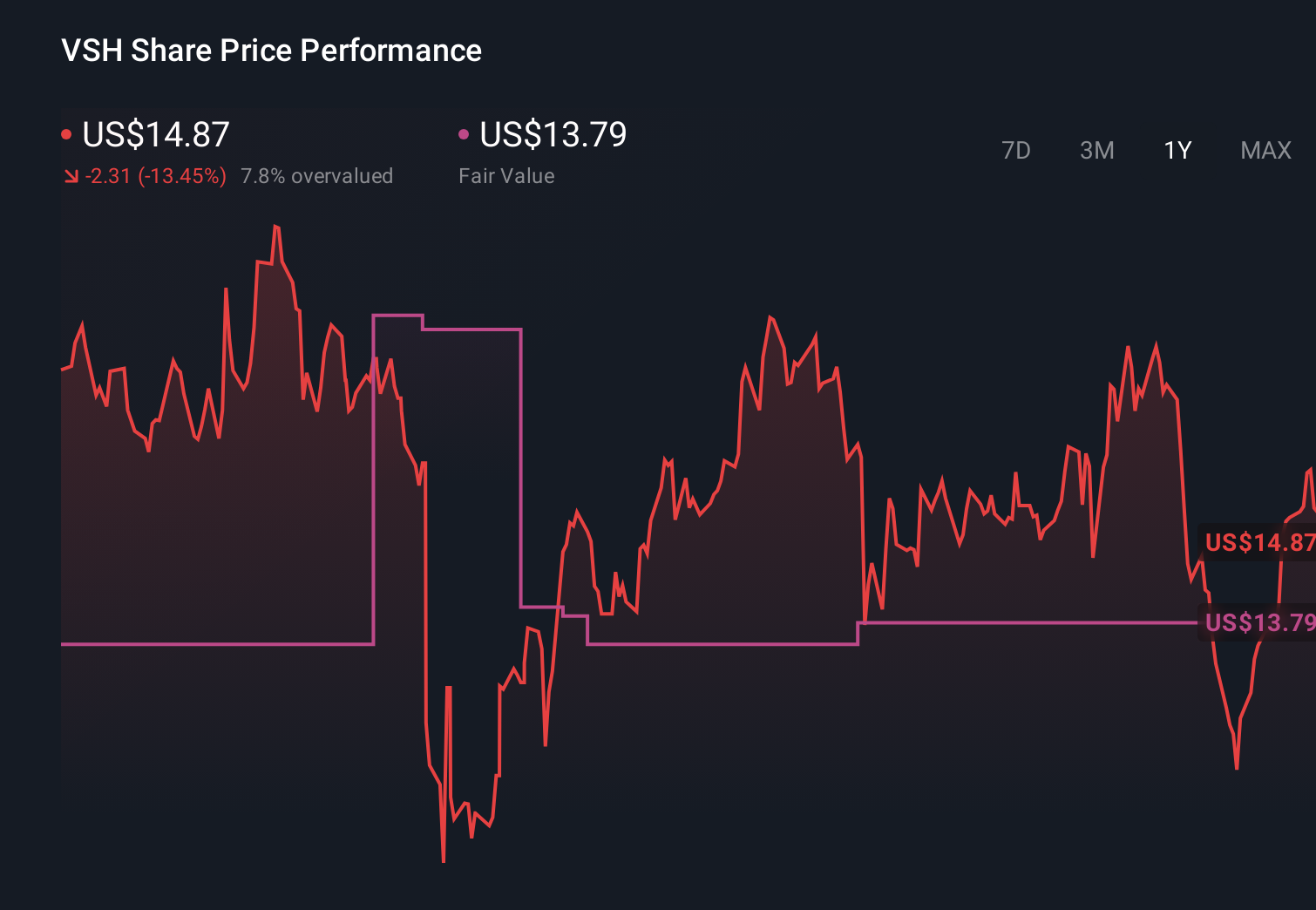
The more optimistic analysts were already assuming Vishay could reach about US$4.0 billion in revenue and US$413.4 million in earnings, which is far more upbeat than consensus, so this latest profitability and AI linked product momentum may either support their view or prompt a rethink, depending on how you weigh that upside against the execution and capacity risks just discussed.
Explore 3 other fair value estimates on Vishay Intertechnology - why the stock might be worth 35% less than the current price!
Build Your Own Vishay Intertechnology Narrative
Disagree with existing narratives? Create your own in under 3 minutes - extraordinary investment returns rarely come from following the herd.
- A great starting point for your Vishay Intertechnology research is our analysis highlighting 2 key rewards and 1 important warning sign that could impact your investment decision.
- Our free Vishay Intertechnology research report provides a comprehensive fundamental analysis summarized in a single visual - the Snowflake - making it easy to evaluate Vishay Intertechnology's overall financial health at a glance.
Seeking Other Investments?
These stocks are moving-our analysis flagged them today. Act fast before the price catches up:
- AI is about to change healthcare. These 25 stocks are working on everything from early diagnostics to drug discovery. The best part - they are all under $10b in market cap - there's still time to get in early.
- The future of work is here. Discover the 30 top robotics and automation stocks leading the charge in AI-driven automation and industrial transformation.
- Explore 23 top quantum computing companies leading the revolution in next-gen technology and shaping the future with breakthroughs in quantum algorithms, superconducting qubits, and cutting-edge research.
This article by Simply Wall St is general in nature. We provide commentary based on historical data and analyst forecasts only using an unbiased methodology and our articles are not intended to be financial advice. It does not constitute a recommendation to buy or sell any stock, and does not take account of your objectives, or your financial situation. We aim to bring you long-term focused analysis driven by fundamental data. Note that our analysis may not factor in the latest price-sensitive company announcements or qualitative material. Simply Wall St has no position in any stocks mentioned.
Have feedback on this article? Concerned about the content? Get in touch with us directly. Alternatively, email editorial-team@simplywallst.com