

Assessing American Electric Power (AEP) After Strong 1-Year Share Price Rally
- If you are wondering whether American Electric Power Company is reasonably priced after its recent run, this article walks through what the numbers actually suggest about value, not just the share price.
- The stock last closed at US$129.37, with returns of 10.9% over the past 30 days and 26.9% over the last year, adding to longer term returns of 60.1% over 3 years and 107.3% over 5 years.
- Recent coverage around American Electric Power Company has focused on its role as a large regulated utility and how investors may be weighing stability against changing rate expectations. This context has helped shape how the market is thinking about risk and potential reward for a stock that many view as a core income and infrastructure holding.
- Simply Wall St currently gives American Electric Power Company a valuation score of 3 out of 6, based on how many checks suggest the stock screens as undervalued. Next, we will walk through the standard valuation approaches behind that score, then finish with a more complete way to think about what the company might be worth.
Approach 1: American Electric Power Company Dividend Discount Model (DDM) Analysis
The Dividend Discount Model estimates what a stock could be worth today by projecting future dividends and discounting them back to the present. It is a way of asking whether the income you receive as a shareholder justifies the current price.
For American Electric Power Company, the latest annual dividend per share used in the model is US$4.20. The company’s return on equity is 10.42%, with a payout ratio of about 69.92%. That leaves roughly 30.08% of earnings to reinvest, which the model translates into an expected dividend growth rate of about 3.13%. This growth rate is calculated mechanically using the formula in the data, so it reflects the current payout and profitability rather than any wider macro view.
Using these inputs, the DDM estimate of fair value is US$109.32 per share. Compared with the recent share price of US$129.37, the model implies the stock is about 18.3% above its dividend based intrinsic value, so the shares screen as overvalued on this metric alone.
Result: OVERVALUED
Our Dividend Discount Model (DDM) analysis suggests American Electric Power Company may be overvalued by 18.3%. Discover 54 high quality undervalued stocks or create your own screener to find better value opportunities.

Approach 2: American Electric Power Company Price vs Earnings
For a profitable company like American Electric Power Company, the P/E ratio is a straightforward way to connect what you pay for each share with the earnings that back it. In general, higher growth expectations and lower perceived risk can support a higher “normal” or “fair” P/E, while lower growth or higher risk usually call for a lower multiple.
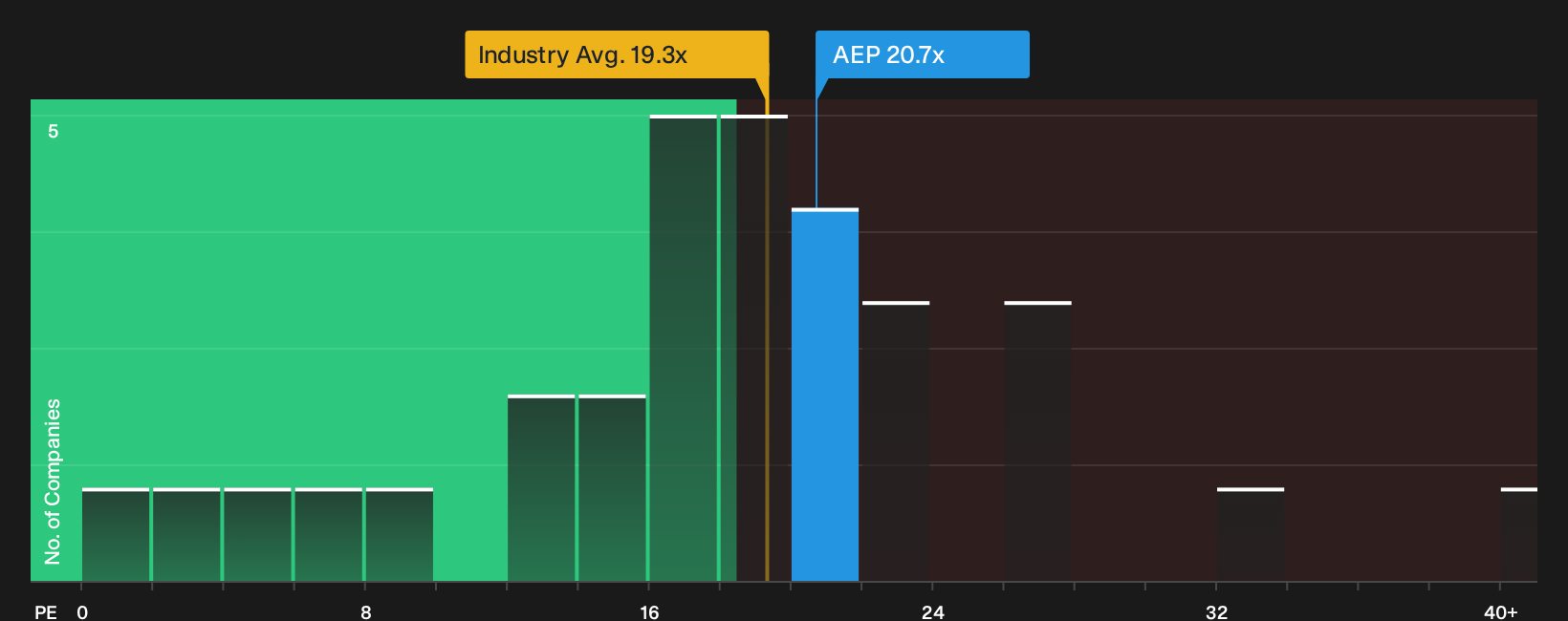
American Electric Power Company currently trades on a P/E of 19.55x. That sits below the Electric Utilities industry average of 22.25x and also below the peer group average of 25.26x, which might initially suggest the stock is priced more conservatively than many of its peers.
Simply Wall St’s Fair Ratio for American Electric Power Company is 24.67x. This is a proprietary estimate of the P/E you might expect given the company’s earnings growth profile, industry, profit margins, market value and key risks. Because it blends these specific factors, the Fair Ratio aims to give a more tailored anchor than a simple comparison with industry or peer averages, which can be skewed by outliers or very different business profiles.
Comparing the current P/E of 19.55x with the Fair Ratio of 24.67x suggests the shares screen as undervalued on this metric.
Result: UNDERVALUED
P/E ratios tell one story, but what if the real opportunity lies elsewhere? Start investing in legacies, not executives. Discover our 22 top founder-led companies.
Upgrade Your Decision Making: Choose your American Electric Power Company Narrative
Earlier we mentioned that there is an even better way to understand valuation. On Simply Wall St’s Community page you can use Narratives, where you set out your own story for American Electric Power Company by plugging in assumptions for future revenue, earnings, margins and a fair value. You can then compare that to today’s share price to help judge whether it looks like a buy, a hold, or a sell for you. Because Narratives update automatically when new information such as news, earnings, regulatory developments or valuation changes arrive, you can see how different views play out in real time.
For example, one investor might focus on analysts’ fair value of about US$128.75 with revenue growth of about 7.76%, a profit margin of about 16.09% and a future P/E of about 19.96x. Another might lean on the US$115.00 consensus price target that implies lower expectations. Together these contrasting Narratives show how the same company can support different, but clearly quantified, views on what the shares might be worth today.
Do you think there's more to the story for American Electric Power Company? Head over to our Community to see what others are saying!

This article by Simply Wall St is general in nature. We provide commentary based on historical data and analyst forecasts only using an unbiased methodology and our articles are not intended to be financial advice. It does not constitute a recommendation to buy or sell any stock, and does not take account of your objectives, or your financial situation. We aim to bring you long-term focused analysis driven by fundamental data. Note that our analysis may not factor in the latest price-sensitive company announcements or qualitative material. Simply Wall St has no position in any stocks mentioned.
Have feedback on this article? Concerned about the content? Get in touch with us directly. Alternatively, email editorial-team@simplywallst.com