


Why recent profitability concerns are drawing attention to First Busey
Recent commentary around First Busey (BUSE) has focused on a weaker net interest margin and expectations for lower tangible book value per share, raising fresh questions about the bank's profitability and credit quality profile.
See our latest analysis for First Busey.
At a share price of US$25.48, First Busey has a 30 day share price return of 3.54% and a 1 year total shareholder return of 11.25%. This suggests some recent momentum, despite a weaker 7 day share price return of 3.99%, as investors reassess profitability and credit risk.
If this banking update has you thinking about where else capital could work harder, it might be worth broadening your search with our 22 top founder-led companies as a next step.
With annual revenue of US$666.841m, net income of US$125.386m and an indicated intrinsic discount close to 51%, the key question is whether recent profitability concerns justify this gap or if the market is already correctly pricing in future growth.
Price to earnings of 17.8x, is it justified?
First Busey is trading on a P/E of 17.8x, which sits above several benchmarks and puts the current $25.48 share price under a higher expectations spotlight.
The P/E ratio compares the share price to earnings per share, so a higher number often reflects the market paying more today for each dollar of current earnings. For a bank, that can signal investors are pricing in stronger profit growth or a higher quality earnings stream.
Here, the tension is clear. On one hand, BUSE is described as expensive on P/E versus the US Banks industry average of 11.6x and a peer average of 12.5x. It is also above an estimated fair P/E of 15.9x, which suggests a level that the market could potentially move toward if sentiment cools or earnings do not keep pace. On the other hand, the company is assessed as trading 50.5% below an estimated fair value based on future cash flows, and earnings are forecast to grow 27.91% per year with high quality earnings flagged, which helps explain why a richer multiple might be supported by some investors despite recent margin pressure and lower return on equity.
That comparison, expensive against both industry and fair ratio benchmarks yet paired with a large intrinsic discount and strong forecast earnings growth, makes the current P/E a key focal point for anyone assessing whether expectations embedded in the price feel stretched or acceptable for a bank with these characteristics.
Explore the SWS fair ratio for First Busey
Result: Price-to-earnings of 17.8x (OVERVALUED)
However, if net interest margin pressure deepens or credit quality weakens materially, the current valuation case around earnings quality and intrinsic discount could quickly lose traction.
Find out about the key risks to this First Busey narrative.
Another view on value, using future cash flows instead
While the 17.8x P/E hints at a richer price tag, our DCF model points the other way. With First Busey at $25.48 versus an estimated future cash flow value of $51.50, this approach frames the shares as significantly undervalued. Which lens do you put more weight on when numbers conflict like this?
Look into how the SWS DCF model arrives at its fair value.
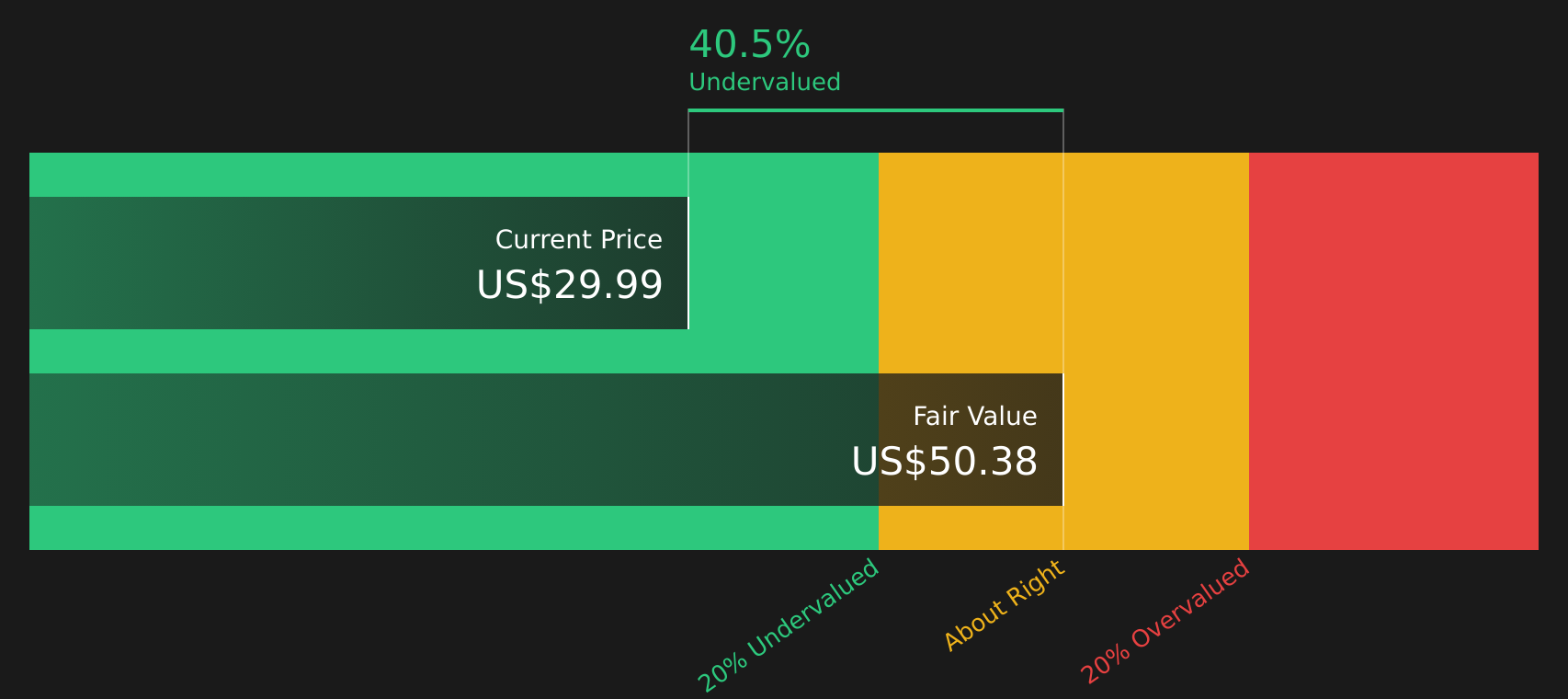
Simply Wall St performs a discounted cash flow (DCF) on every stock in the world every day (check out First Busey for example). We show the entire calculation in full. You can track the result in your watchlist or portfolio and be alerted when this changes, or use our stock screener to discover 51 high quality undervalued stocks. If you save a screener we even alert you when new companies match - so you never miss a potential opportunity.
Next Steps
Mixed signals on value and risks so far, so if this has your attention, consider reviewing it while the data is fresh and weigh it up yourself with 3 key rewards and 1 important warning sign.
Looking for more investment ideas?
If you are weighing up what to do next after looking at First Busey, it can help to compare it with other ideas that fit different criteria.
- Spot potential value entries by running your own comparison against our 51 high quality undervalued stocks and see how other companies stack up.
- Prioritise resilience by checking companies that pass our quality and balance sheet filters through the solid balance sheet and fundamentals stocks screener (40 results).
- Hunt for opportunities the market may be missing by scanning the screener containing 23 high quality undiscovered gems before attention shifts and prices adjust.
This article by Simply Wall St is general in nature. We provide commentary based on historical data and analyst forecasts only using an unbiased methodology and our articles are not intended to be financial advice. It does not constitute a recommendation to buy or sell any stock, and does not take account of your objectives, or your financial situation. We aim to bring you long-term focused analysis driven by fundamental data. Note that our analysis may not factor in the latest price-sensitive company announcements or qualitative material. Simply Wall St has no position in any stocks mentioned.
Have feedback on this article? Concerned about the content? Get in touch with us directly. Alternatively, email editorial-team@simplywallst.com