


What TFS Financial’s Recent Returns May Be Telling Investors
TFS Financial (TFSL) has drawn attention after a mixed run in its share price, with a 0.4% move over the past day, weaker performance over the past month, but a stronger 1 year total return.
For investors, the combination of recent short term weakness, a modest year to date decline, and a higher 3 year total return raises the question of whether the current share price still reflects the bank’s underlying retail-focused business.
See our latest analysis for TFS Financial.
At the current share price of $13.51, TFS Financial’s recent 30 day share price return of a 9.75% decline contrasts with a 1 year total shareholder return of 19.26% and a 3 year total shareholder return of 37.21%. This suggests that recent weakness sits against a stronger long term record.
If this movement has you thinking about where else value might be hiding in the market, it could be a good moment to broaden your search with our screener of 18 top founder-led companies.
So with TFS Financial sharing a 30 day decline, longer term gains, modest revenue and net income growth, and a share price that sits below the average analyst target, is this a potential entry point, or is the market already pricing in future growth?
Price-to-Earnings of 42.2x: Is It Justified?
On the latest figures, TFS Financial trades on a P/E of 42.2x, which sits against a last close price of $13.51 and points to a rich valuation compared with many peers.
The P/E ratio compares the current share price to the company’s earnings per share, so a higher multiple usually means investors are paying more for each dollar of earnings. For a retail focused bank like TFS Financial, a multiple at this level suggests the market is placing a premium on its current earnings profile, rather than treating it like a typical US bank.
That premium stands out when you line it up next to the broader industry. TFS Financial’s 42.2x P/E is well above the US Banks industry average of 11.2x, above the peer average of 13.5x, and also above an estimated fair P/E of 11.5x that the SWS model suggests the market could gravitate toward if sentiment or expectations reset.
Explore the SWS fair ratio for TFS Financial
Result: Price-to-Earnings of 42.2x (OVERVALUED)
However, you also need to weigh risks such as TFS Financial’s higher 42.2x P/E and any shift in expectations around its retail-focused US banking model.
Find out about the key risks to this TFS Financial narrative.
Another View: What The SWS DCF Model Says
There is a very different signal when you look at our DCF model. On this approach, TFS Financial at $13.51 is trading well above an estimated future cash flow value of $1.29, which points to an overvalued result rather than a premium that earnings alone might justify.
For you as an investor, that gap raises a practical question: is the current price leaning more on sentiment and income appeal, or on cash flows that the SWS DCF model does not fully back up?
Look into how the SWS DCF model arrives at its fair value.
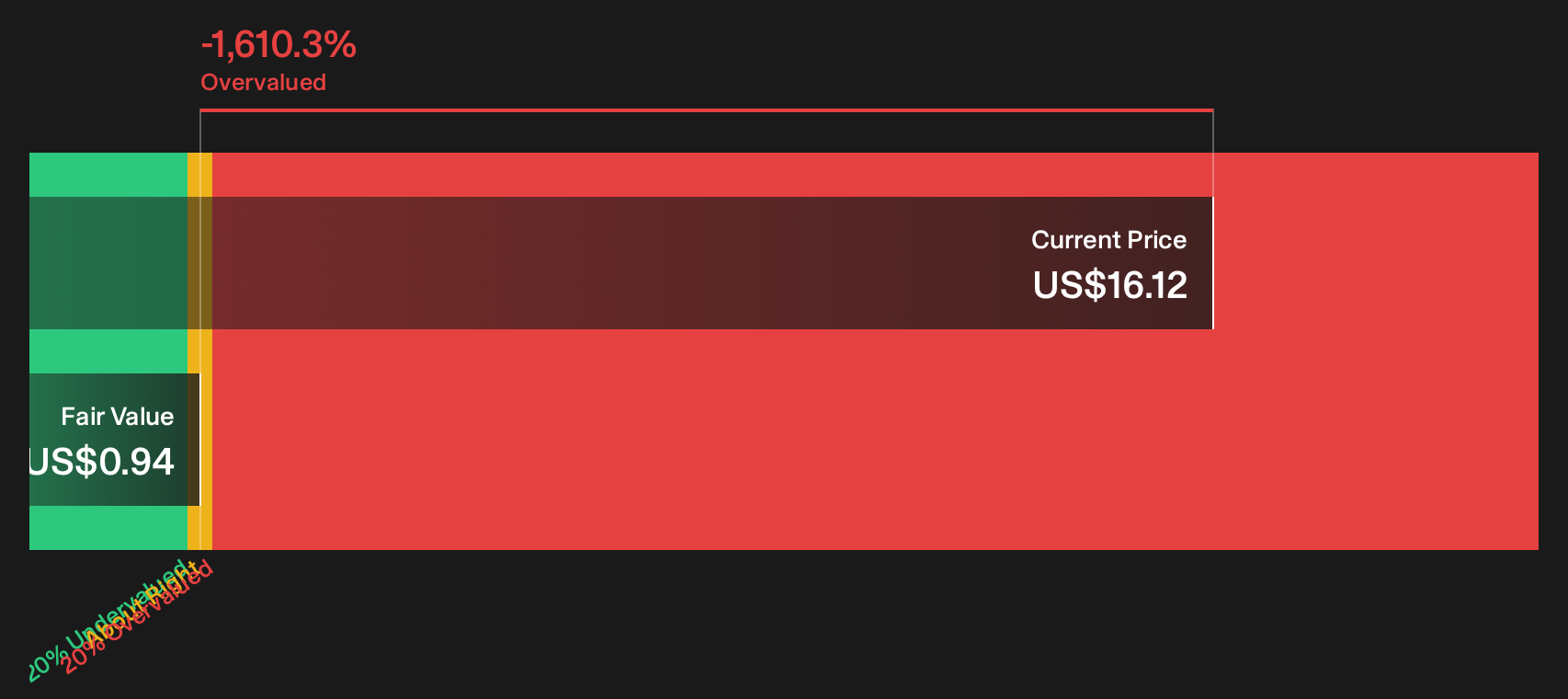
Simply Wall St performs a discounted cash flow (DCF) on every stock in the world every day (check out TFS Financial for example). We show the entire calculation in full. You can track the result in your watchlist or portfolio and be alerted when this changes, or use our stock screener to discover 48 high quality undervalued stocks. If you save a screener we even alert you when new companies match - so you never miss a potential opportunity.
Next Steps
If this mix of signals feels balanced rather than clear cut, it is worth looking through the numbers yourself and deciding where you stand. This is especially relevant given the mix of risks and rewards flagged by our analysis through 2 key rewards and 2 important warning signs.
Looking for more investment ideas?
If you are weighing up what to do next, it makes sense to widen your watchlist and compare TFS Financial with other clearly defined sets of opportunities.
- Target potential mispricing by checking companies our screen highlights as 48 high quality undervalued stocks and see which names look interesting on your terms.
- Prioritise resilience by scanning stocks in our 68 resilient stocks with low risk scores that score well on key risk checks and may suit a steadier approach.
- Hunt for fresh names by reviewing our screener containing 26 high quality undiscovered gems and spot businesses that have not yet attracted broad attention.
This article by Simply Wall St is general in nature. We provide commentary based on historical data and analyst forecasts only using an unbiased methodology and our articles are not intended to be financial advice. It does not constitute a recommendation to buy or sell any stock, and does not take account of your objectives, or your financial situation. We aim to bring you long-term focused analysis driven by fundamental data. Note that our analysis may not factor in the latest price-sensitive company announcements or qualitative material. Simply Wall St has no position in any stocks mentioned.
Have feedback on this article? Concerned about the content? Get in touch with us directly. Alternatively, email editorial-team@simplywallst.com