


- The Chemours Company recently completed a private offering of US$700,000,000 in 7.875% senior unsecured notes due 2034, using the proceeds and cash on hand to redeem existing 5.750% notes due 2028 and 5.375% notes due 2027.
- This refinancing, alongside a very large 31.5% increase in CEO Denise Dignam's 2025 compensation, highlights how Chemours is reshaping its balance sheet while drawing attention to management incentives and governance.
- We will now examine how this major debt refinancing affects Chemours' investment narrative, particularly its capital structure and long-term financial flexibility.
Outshine the giants: these 20 early-stage AI stocks could fund your retirement.
Chemours Investment Narrative Recap
To own Chemours, you need to be comfortable with a chemicals business that is still unprofitable, carries environmental and legal overhangs from PFAS, and depends heavily on Opteon and TiO₂ for future earnings improvement. The recent US$700,000,000 refinancing extends debt maturities but at a higher coupon, which does not materially change the key near term catalyst of earnings recovery or the biggest current risk around PFAS liabilities and related cash outflows.
The most directly relevant recent announcement is the Board’s decision to cut the quarterly dividend from US$0.25 to US$0.0875 per share in 2025, then hold it flat into early 2026. Paired with the new 7.875% notes and the planned redemption of lower coupon 2027 and 2028 notes, this points to a cautious capital allocation stance that keeps more cash inside the business while it faces ongoing PFAS, regulatory and TiO₂ market risks.
Yet behind the refinancing and dividend reset, investors should also be aware of the potential for large, lingering PFAS related cash calls that could still...
Read the full narrative on Chemours (it's free!)
Chemours’ narrative projects $6.6 billion revenue and $671.0 million earnings by 2028.
Uncover how Chemours' forecasts yield a $16.33 fair value, a 7% downside to its current price.
Exploring Other Perspectives
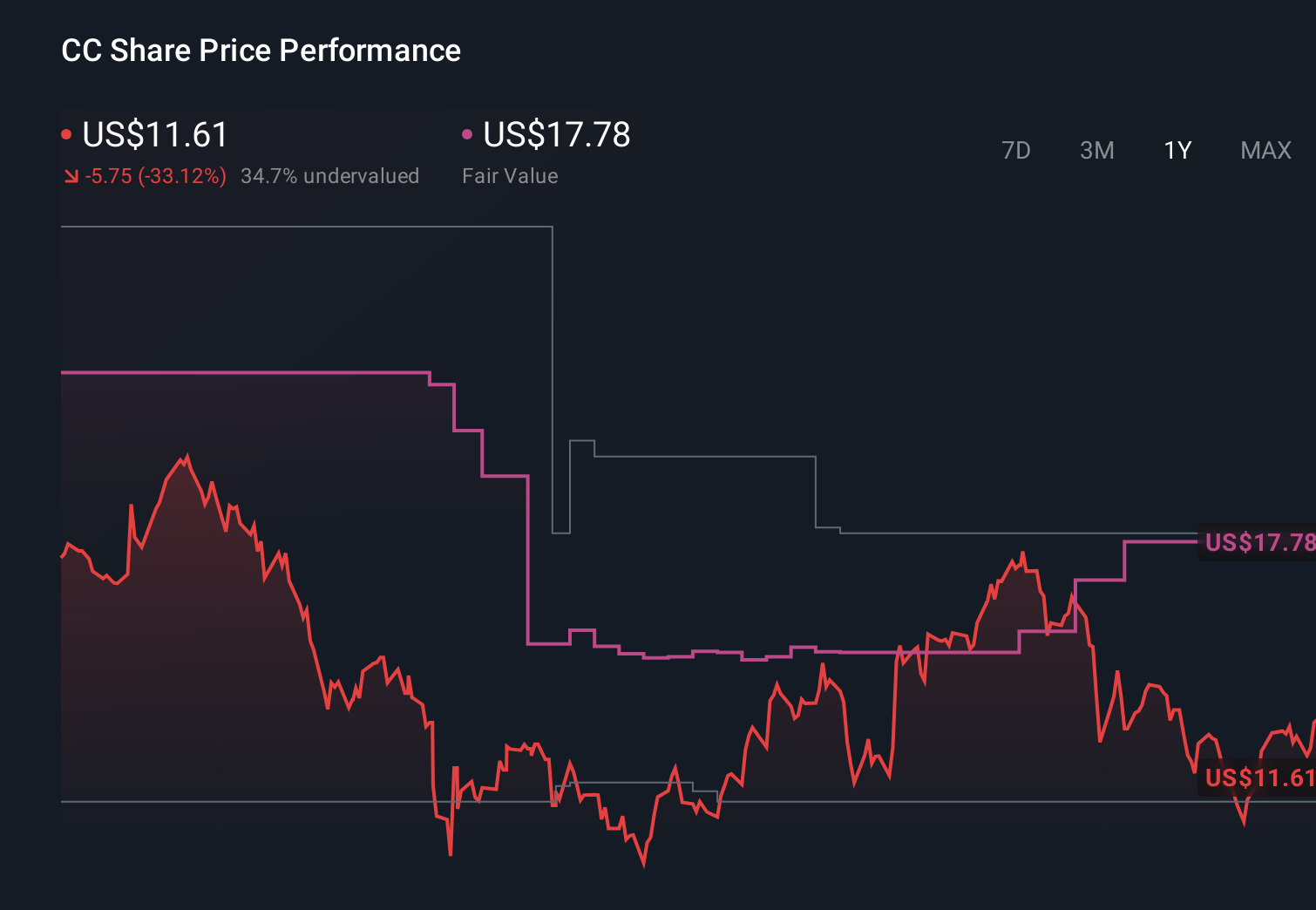
Before this refinancing, the most optimistic analysts were banking on revenue reaching about US$6.7 billion and earnings of roughly US$548 million by 2028, which is far more upbeat than consensus and sits uncomfortably next to the reminder that sizeable PFAS related cash outflows could still pressure Chemours’ balance sheet and reshape those projections once this new debt move is fully reflected.
Explore 4 other fair value estimates on Chemours - why the stock might be worth 20% less than the current price!
Reach Your Own Conclusion
Don't just follow the ticker - dig into the data and build a conviction that's truly your own.
- A great starting point for your Chemours research is our analysis highlighting 3 key rewards and 2 important warning signs that could impact your investment decision.
- Our free Chemours research report provides a comprehensive fundamental analysis summarized in a single visual - the Snowflake - making it easy to evaluate Chemours' overall financial health at a glance.
Seeking Other Investments?
Markets shift fast. These stocks won't stay hidden for long. Get the list while it matters:
- Uncover the next big thing with 33 elite penny stocks that balance risk and reward.
- AI is about to change healthcare. These 34 stocks are working on everything from early diagnostics to drug discovery. The best part - they are all under $10b in market cap - there's still time to get in early.
- We've uncovered the 14 dividend fortresses yielding 5%+ that don't just survive market storms, but thrive in them.
This article by Simply Wall St is general in nature. We provide commentary based on historical data and analyst forecasts only using an unbiased methodology and our articles are not intended to be financial advice. It does not constitute a recommendation to buy or sell any stock, and does not take account of your objectives, or your financial situation. We aim to bring you long-term focused analysis driven by fundamental data. Note that our analysis may not factor in the latest price-sensitive company announcements or qualitative material. Simply Wall St has no position in any stocks mentioned.
Have feedback on this article? Concerned about the content? Get in touch with us directly. Alternatively, email editorial-team@simplywallst.com