


- Pitney Bowes recently reported generating US$358.3 million in free cash flow in 2025 while spending US$378 million on share repurchases, and its new CEO Kurt Wolf acknowledged past Presort pricing missteps as the company proceeds with a Phase 2 strategic review due by the end of Q2 2026.
- This combination of robust cash generation, aggressive buybacks, and a pending strategic review has sharpened attention on how Pitney Bowes might extract standalone value from a structurally challenged business mix.
- Next, we’ll examine how Pitney Bowes’ strong free cash flow alongside its extensive buybacks could reshape the company’s broader investment narrative.
Uncover the next big thing with 32 elite penny stocks that balance risk and reward.
Pitney Bowes Investment Narrative Recap
To own Pitney Bowes today, you have to believe that its strong free cash flow and capital returns can more than offset structural decline in mailing and Presort. The latest results and US$378.0 million of buybacks sharpen the focus on the Phase 2 strategic review as the key near term catalyst, while the biggest risk remains that volume and pricing in Presort continue to erode, limiting the benefits of any portfolio or capital allocation moves.
Against this backdrop, the recent US$150.0 million issuance of 7.250% Senior Notes due 2029 matters because it highlights Pitney Bowes’ reliance on debt markets at a time of heavy buybacks and ongoing restructuring. How the company balances refinancing needs, interest costs and further capital returns will interact directly with the upcoming strategic review and could influence how much flexibility management has if end markets weaken further.
Yet investors should also be aware that if Presort volumes disappoint again, the high fixed cost base could...
Read the full narrative on Pitney Bowes (it's free!)
Pitney Bowes’ narrative projects $1.9 billion revenue and $348.2 million earnings by 2028.
Uncover how Pitney Bowes' forecasts yield a $12.50 fair value, a 23% upside to its current price.
Exploring Other Perspectives
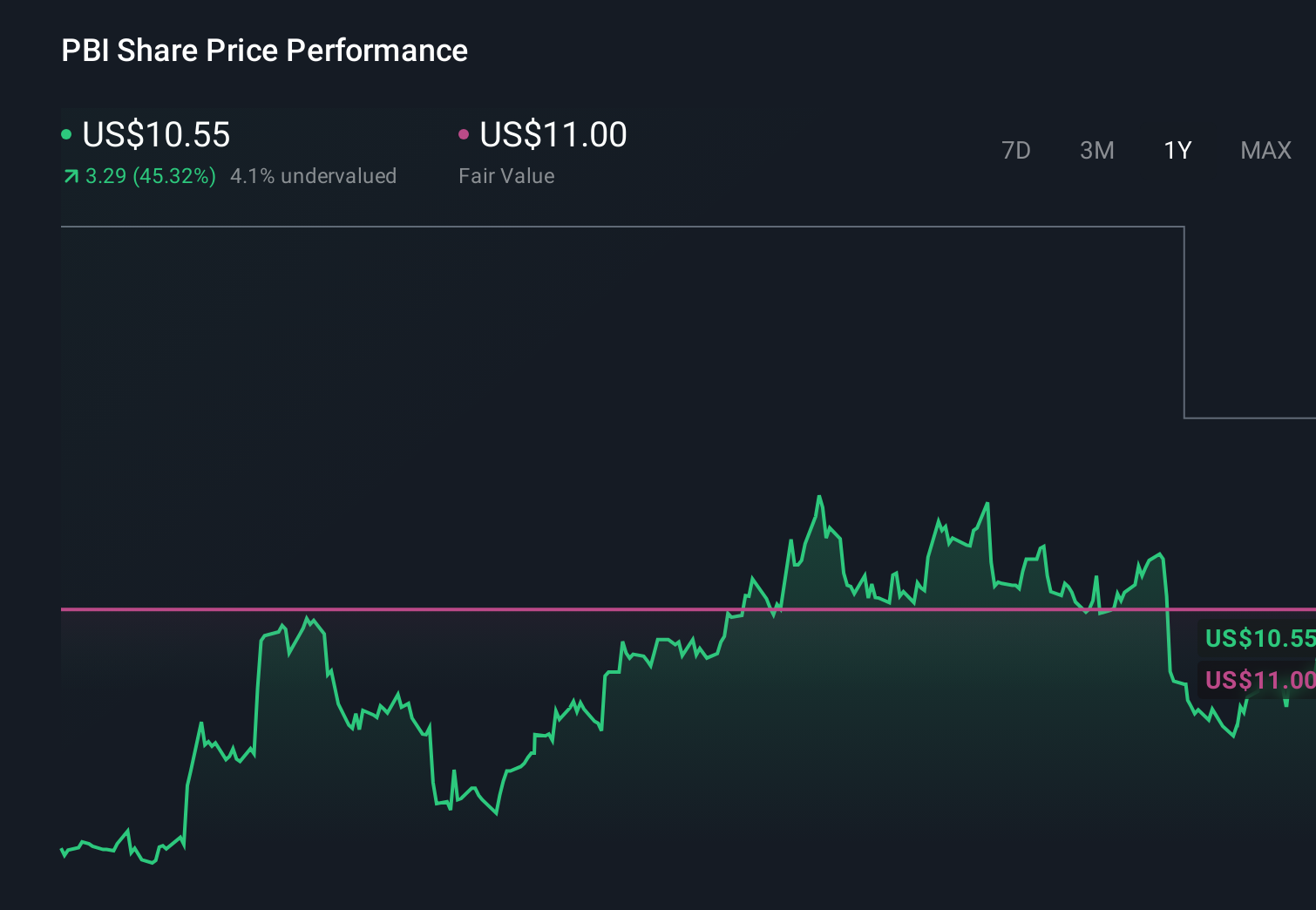
Before this update, the most optimistic analysts were assuming roughly US$1.9 billion of revenue and about US$340 million in earnings by 2029, which is a far more upbeat view than consensus. When you compare that to the new focus on forecasting issues and the risk that any volume losses in high fixed cost Presort could disproportionately hit EBIT, it underlines how widely opinions can differ and why these bullish assumptions may be revisited as the story evolves.
Explore 6 other fair value estimates on Pitney Bowes - why the stock might be worth over 3x more than the current price!
Form Your Own Verdict
Disagree with existing narratives? Extraordinary investment returns rarely come from following the herd, so go with your instincts.
- A great starting point for your Pitney Bowes research is our analysis highlighting 4 key rewards and 3 important warning signs that could impact your investment decision.
- Our free Pitney Bowes research report provides a comprehensive fundamental analysis summarized in a single visual - the Snowflake - making it easy to evaluate Pitney Bowes' overall financial health at a glance.
Looking For Alternative Opportunities?
Our top stock finds are flying under the radar-for now. Get in early:
- Rare earth metals are the new gold rush. Find out which 28 stocks are leading the charge.
- Explore 24 top quantum computing companies leading the revolution in next-gen technology and shaping the future with breakthroughs in quantum algorithms, superconducting qubits, and cutting-edge research.
- Find 49 companies with promising cash flow potential yet trading below their fair value.
This article by Simply Wall St is general in nature. We provide commentary based on historical data and analyst forecasts only using an unbiased methodology and our articles are not intended to be financial advice. It does not constitute a recommendation to buy or sell any stock, and does not take account of your objectives, or your financial situation. We aim to bring you long-term focused analysis driven by fundamental data. Note that our analysis may not factor in the latest price-sensitive company announcements or qualitative material. Simply Wall St has no position in any stocks mentioned.
Have feedback on this article? Concerned about the content? Get in touch with us directly. Alternatively, email editorial-team@simplywallst.com