


- Earlier this week, Oppenheimer lowered its gross merchandise sales and profit estimates for Etsy, citing uncertainty around consumer spending linked to rising gas prices and the Middle East conflict.
- The brokerage also emphasized that Etsy’s reliance on highly discretionary goods and plateauing active buyers may leave it more exposed to higher fuel costs than many other online marketplaces, even as it prioritizes AI-driven personalization over discounts to support engagement.
- We’ll now examine how Oppenheimer’s concerns about Etsy’s discretionary mix and consumer sensitivity to gas prices affect its investment narrative.
Capitalize on the AI infrastructure supercycle with our selection of the 35 best 'picks and shovels' of the AI gold rush converting record-breaking demand into massive cash flow.
Etsy Investment Narrative Recap
To own Etsy, you need to believe that a differentiated marketplace for unique, discretionary goods can keep buyers engaged even when budgets tighten. Oppenheimer’s cut to gross merchandise sales and profit estimates underscores how rising gas prices and geopolitical tension could weigh on near term spending, especially with buyer growth already plateauing. The key near term catalyst remains Etsy’s push into AI driven personalization, while the biggest risk is that weaker consumer demand keeps GMS and buyer activity under sustained pressure.
The recent integration with PrintKK, which lets Etsy sellers offer customized products globally without holding inventory, ties directly into that catalyst story. It broadens Etsy’s product range and could help offset softer discretionary demand by making it easier and cheaper for sellers to test new items and reach more buyers. Whether this incremental supply and convenience fully counterbalances macro headwinds for high discretion purchases remains an open question for investors.
Yet, while these growth tools are promising, the risk that rising fuel costs and weaker buyer engagement weigh more heavily on Etsy’s already pressured GMS is something investors should be aware of...
Read the full narrative on Etsy (it's free!)
Etsy's narrative projects $3.2 billion revenue and $377.3 million earnings by 2028.
Uncover how Etsy's forecasts yield a $61.73 fair value, a 30% upside to its current price.
Exploring Other Perspectives
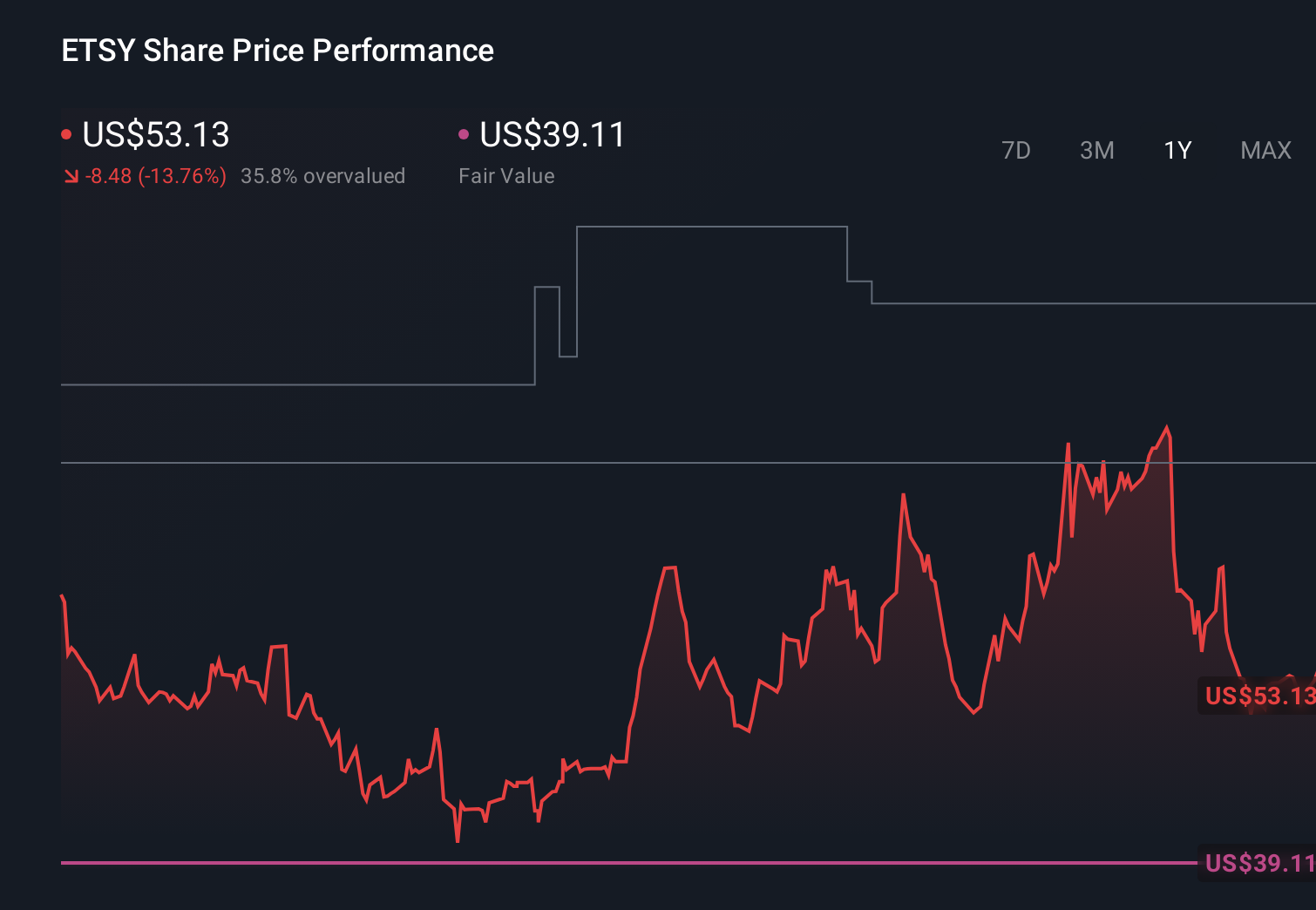
Some of the more pessimistic analysts were already assuming roughly flat revenues around US$2.8 billion and lower margins, so you should know their concerns about Etsy’s shift toward customer experience over pure conversion could look even harsher in light of this gas price driven demand risk.
Explore 6 other fair value estimates on Etsy - why the stock might be worth just $61.73!
The Verdict Is Yours
Disagree with existing narratives? Extraordinary investment returns rarely come from following the herd, so go with your instincts.
- A great starting point for your Etsy research is our analysis highlighting 3 key rewards and 4 important warning signs that could impact your investment decision.
- Our free Etsy research report provides a comprehensive fundamental analysis summarized in a single visual - the Snowflake - making it easy to evaluate Etsy's overall financial health at a glance.
Looking For Alternative Opportunities?
Our top stock finds are flying under the radar-for now. Get in early:
- Invest in the nuclear renaissance through our list of 89 elite nuclear energy infrastructure plays powering the global AI revolution.
- We've uncovered the 12 dividend fortresses yielding 5%+ that don't just survive market storms, but thrive in them.
- This technology could replace computers: discover 22 stocks that are working to make quantum computing a reality.
This article by Simply Wall St is general in nature. We provide commentary based on historical data and analyst forecasts only using an unbiased methodology and our articles are not intended to be financial advice. It does not constitute a recommendation to buy or sell any stock, and does not take account of your objectives, or your financial situation. We aim to bring you long-term focused analysis driven by fundamental data. Note that our analysis may not factor in the latest price-sensitive company announcements or qualitative material. Simply Wall St has no position in any stocks mentioned.
Have feedback on this article? Concerned about the content? Get in touch with us directly. Alternatively, email editorial-team@simplywallst.com