


- MetLife, Inc. recently saw AM Best affirm its Superior financial strength and credit ratings with a stable outlook, while also naming Jordan Canter as head of Federal Government Affairs and Regulatory Policy and appointing Andrea Drasites to lead MetLife Investment Management’s global Real Estate and Agricultural Finance business from late 2026.
- Together, the rating affirmation and senior hires underline MetLife’s focus on regulatory engagement and institutional asset management depth at a time when investors are closely watching balance sheet quality and policy influence.
- Next, we’ll examine how AM Best’s reaffirmed ratings shape MetLife’s existing investment narrative around capital strength, earnings quality, and growth priorities.
Invest in the nuclear renaissance through our list of 93 elite nuclear energy infrastructure plays powering the global AI revolution.
MetLife Investment Narrative Recap
To own MetLife, you generally need to believe in its ability to convert a strong balance sheet and disciplined underwriting into reliable earnings, while managing interest rate, credit, and regulatory pressures. AM Best’s affirmation of its Superior ratings and stable outlook supports the near term focus on capital strength and balance sheet quality, while the biggest current watchpoint remains credit risk in real assets and how that could influence future capital needs.
Among the latest announcements, AM Best’s reaffirmed A+ financial strength and "aa-" issuer credit ratings stand out as most relevant. The rating decision explicitly cited MetLife’s strong balance sheet and appropriate risk management, which ties directly into investor attention on commercial mortgage loan exposure, reserve adequacy, and the company’s capacity to support its earnings and dividend profile through future credit or rate cycles.
Yet behind the solid ratings, investors should be aware of how further commercial mortgage loan losses could...
Read the full narrative on MetLife (it's free!)
MetLife's narrative projects $87.3 billion revenue and $6.7 billion earnings by 2029.
Uncover how MetLife's forecasts yield a $90.50 fair value, a 28% upside to its current price.
Exploring Other Perspectives
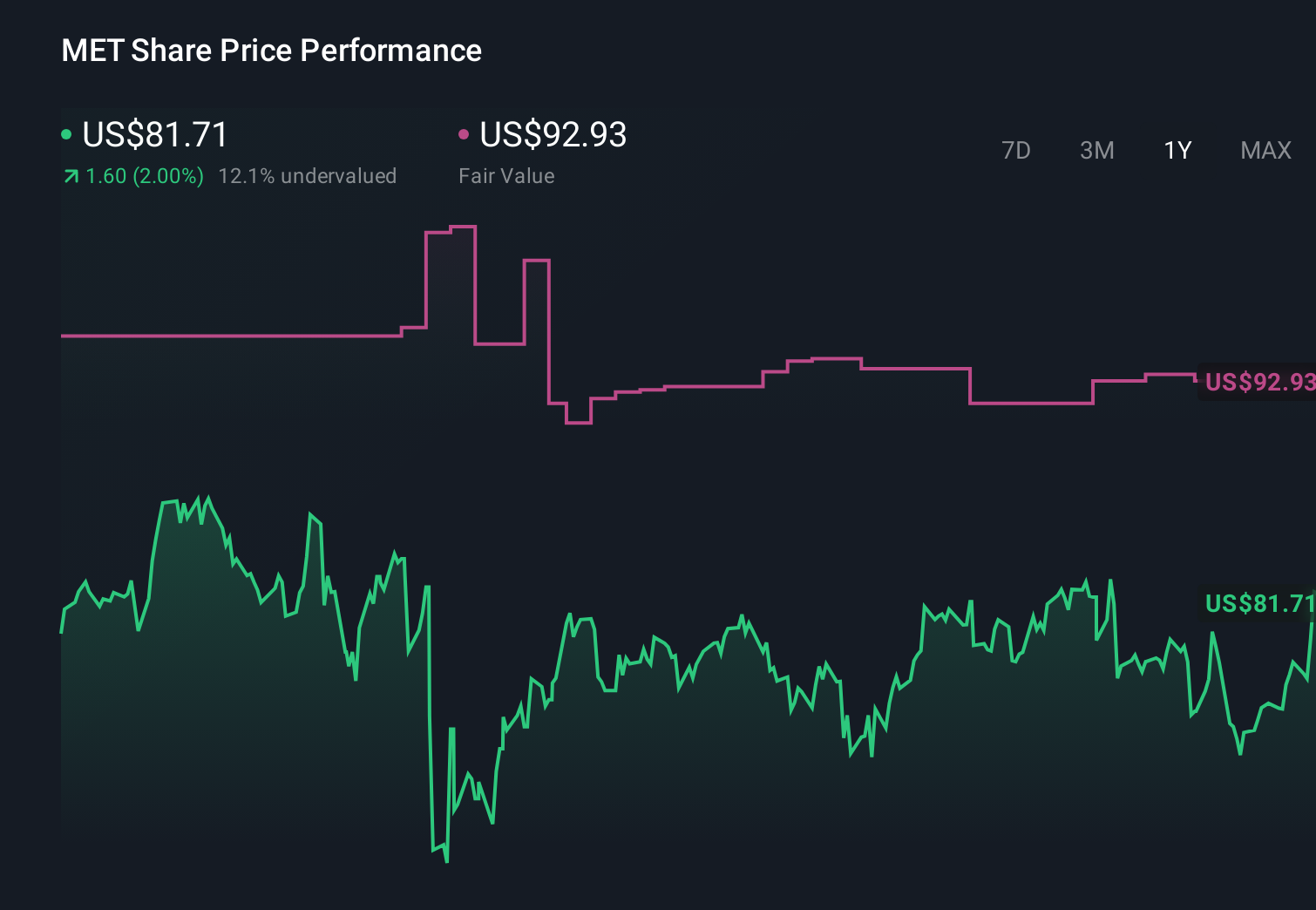
Four members of the Simply Wall St Community currently see MetLife’s fair value between US$77.46 and US$146.27, underscoring how far opinions can differ. When you weigh those views against the highlighted risk around commercial mortgage loan losses and capital buffers, it becomes even more important to compare several perspectives before forming your own stance.
Explore 4 other fair value estimates on MetLife - why the stock might be worth over 2x more than the current price!
Form Your Own Verdict
Disagree with existing narratives? Extraordinary investment returns rarely come from following the herd, so go with your instincts.
- A great starting point for your MetLife research is our analysis highlighting 4 key rewards and 2 important warning signs that could impact your investment decision.
- Our free MetLife research report provides a comprehensive fundamental analysis summarized in a single visual - the Snowflake - making it easy to evaluate MetLife's overall financial health at a glance.
Curious About Other Options?
Our daily scans reveal stocks with breakout potential. Don't miss this chance:
- Uncover the next big thing with 31 elite penny stocks that balance risk and reward.
- The future of work is here. Discover the 33 top robotics and automation stocks leading the charge in AI-driven automation and industrial transformation.
- We've uncovered the 12 dividend fortresses yielding 5%+ that don't just survive market storms, but thrive in them.
This article by Simply Wall St is general in nature. We provide commentary based on historical data and analyst forecasts only using an unbiased methodology and our articles are not intended to be financial advice. It does not constitute a recommendation to buy or sell any stock, and does not take account of your objectives, or your financial situation. We aim to bring you long-term focused analysis driven by fundamental data. Note that our analysis may not factor in the latest price-sensitive company announcements or qualitative material. Simply Wall St has no position in any stocks mentioned.
Have feedback on this article? Concerned about the content? Get in touch with us directly. Alternatively, email editorial-team@simplywallst.com