


- If you are wondering whether 3M's current share price reflects its true worth, the recent mix of gains and pullbacks gives you plenty to think about.
- The stock last closed at US$144.47, with returns of 1% over 7 days, a 7.5% decline over 30 days, a 10.7% decline year to date, a 15.9% gain over the last year, and 4.5% over 5 years.
- Recent coverage of 3M has focused on how the company is repositioning its portfolio and addressing legacy issues that have influenced sentiment around the stock. This context helps explain why the share price has shown both periods of strength and pullbacks over different time frames.
- 3M currently has a valuation score of 5/6. Next, you will see how different valuation methods assess the stock, followed by a more rounded way to think about valuation at the end of the article.
Find out why 3M's 15.9% return over the last year is lagging behind its peers.
Approach 1: 3M Discounted Cash Flow (DCF) Analysis
A Discounted Cash Flow model estimates what a company could be worth by projecting its future cash flows and discounting them back to today, so you can compare that value with the current share price.
For 3M, the model uses a 2 Stage Free Cash Flow to Equity approach based on cash flow projections. The latest twelve month free cash flow is about $1.06b. Analyst and extrapolated estimates see free cash flow reaching $5.16b in 2030, with a path that includes projected annual cash flows such as $3.83b in 2026 and $3.87b in 2027, all in $ and discounted back to present value.
When all projected and extrapolated cash flows are added and discounted, the DCF model points to an estimated intrinsic value of $211.02 per share. Compared with the recent share price of $144.47, this implies the stock trades at a 31.5% discount to that estimate, which suggests 3M is undervalued on this model today.
Result: UNDERVALUED
Our Discounted Cash Flow (DCF) analysis suggests 3M is undervalued by 31.5%. Track this in your watchlist or portfolio, or discover 59 more high quality undervalued stocks.

Approach 2: 3M Price vs Earnings
For profitable companies, the P/E ratio is a useful way to think about value because it links what you pay today to the earnings the business is currently generating. In general, higher growth expectations and lower perceived risk can support a higher P/E, while slower expected growth or higher risk usually point to a lower, more conservative P/E being considered fair.
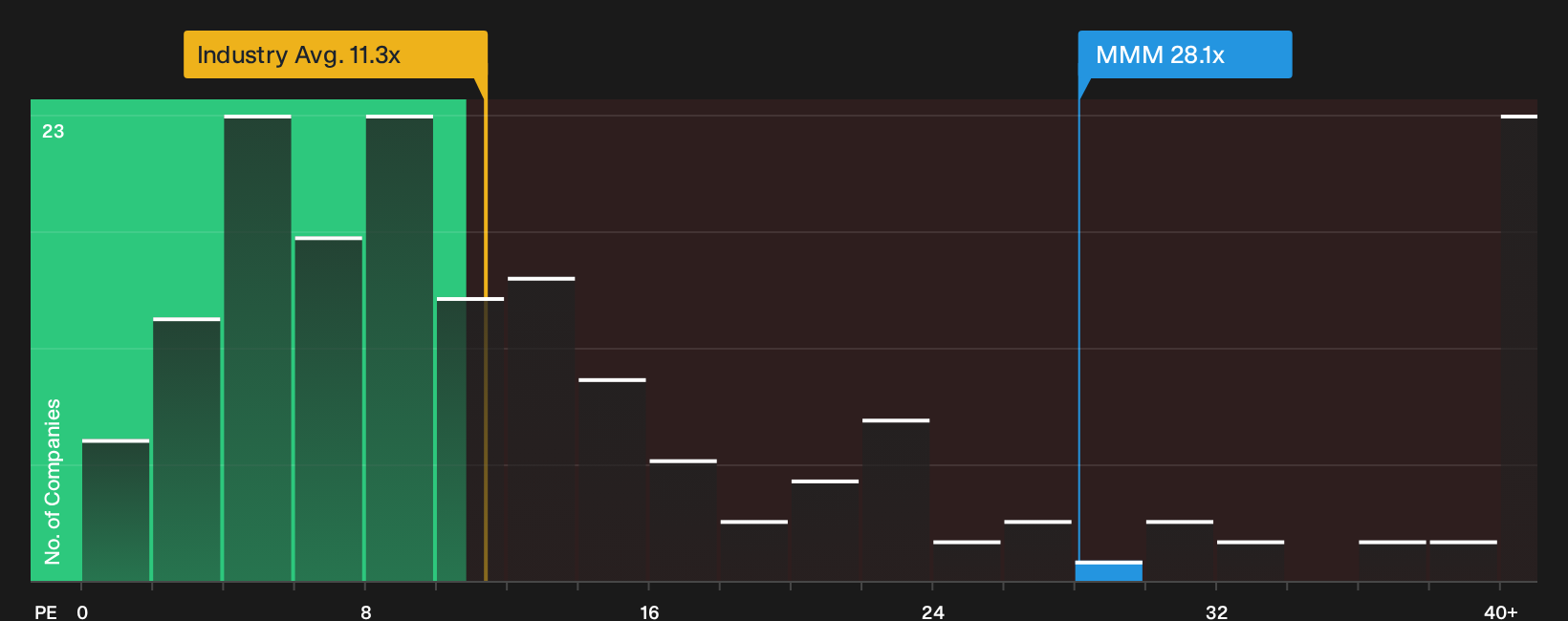
3M trades on a P/E of 23.22x, compared with the Industrials industry average of 13.79x and a peer group average of 31.62x. Simply Wall St also provides a Fair Ratio estimate of 31.50x, which reflects the P/E that might be expected given factors such as earnings growth, profit margins, industry, market cap and company specific risks.
This Fair Ratio is more tailored than a simple peer or industry comparison because it looks beyond headline multiples and attempts to align the P/E with 3M’s own fundamentals and risk profile. Set against this Fair Ratio of 31.50x, the current P/E of 23.22x is lower, which indicates that the shares may be undervalued on this metric.
Result: UNDERVALUED
P/E ratios tell one story, but what if the real opportunity lies elsewhere? Start investing in legacies, not executives. Discover our 20 top founder-led companies.
Upgrade Your Decision Making: Choose your 3M Narrative
Earlier it was mentioned that there is an even better way to understand valuation. Narratives bring this to life by letting you spell out the story you believe about 3M, link it to specific assumptions for future revenue, earnings and margins, and see the Fair Value that falls out of that story, all within Simply Wall St's Community page that millions of investors use.
With Narratives, you compare that Fair Value with the current share price to help decide whether 3M looks more attractive or less attractive to you. Because these Narratives update automatically when new earnings, news or guidance arrive, your view stays connected to fresh information rather than a one off model.
For 3M, one investor might align with the more optimistic Fair Value of about US$225.94 based on assumptions like revenue growth of 3.3% a year and profit margins rising toward roughly 20%. Another might sit closer to the cautious end around US$113.59 where revenue is assumed to contract by 0.7% a year and a lower P/E of about 15.2x is used. Narratives simply make those different stories explicit so you can see which one best matches your own expectations.
For 3M however we will make it really easy for you with previews of two leading 3M Narratives:
Fair value: US$177.32 per share
Implied discount to this fair value: about 18.5% versus the recent US$144.47 share price
Revenue growth assumption: about 2.24% a year
- Analysts building this Narrative are looking for moderate revenue growth, slightly higher profit margins, and ongoing share buybacks to support earnings per share.
- The thesis leans on 3M improving efficiency, focusing on higher growth areas, and managing PFAS and other legal exposures in a way that keeps the balance sheet flexible.
- Under these assumptions, the consensus view is that the current share price sits below the Fair Value that falls out of their earnings, margin, and P/E expectations.
Fair value: US$125.70 per share
Implied premium to this fair value: about 15.0% versus the recent US$144.47 share price
Revenue growth assumption: about 1.16% a year
- This more cautious Narrative leans on slower revenue growth, tighter valuation multiples, and a lower Fair Value that sits closer to the bearish end of analyst targets.
- PFAS litigation, regulatory pressures, portfolio reshaping, and supply chain complexity all feature as key risks that could cap the valuation multiple placed on future earnings.
- On these inputs, the recent share price screens above the Bear case Fair Value, which highlights the downside some analysts see if legal and execution risks play out more fully.
Do you think there's more to the story for 3M? Head over to our Community to see what others are saying!

This article by Simply Wall St is general in nature. We provide commentary based on historical data and analyst forecasts only using an unbiased methodology and our articles are not intended to be financial advice. It does not constitute a recommendation to buy or sell any stock, and does not take account of your objectives, or your financial situation. We aim to bring you long-term focused analysis driven by fundamental data. Note that our analysis may not factor in the latest price-sensitive company announcements or qualitative material. Simply Wall St has no position in any stocks mentioned.
Have feedback on this article? Concerned about the content? Get in touch with us directly. Alternatively, email editorial-team@simplywallst.com