


Erie Indemnity (ERIE) is back in focus as investors look ahead to its upcoming fiscal Q1 2026 earnings, following weaker Q4 2025 results and a mixed track record against recent quarterly expectations.
See our latest analysis for Erie Indemnity.
The upcoming Q1 2026 release comes after a weak Q4 and a clear loss of momentum, with a 90 day share price return decline of 11.5% and a 1 year total shareholder return loss of 36%, even though the stock has bounced 3.6% over the past week to $249.51.
If this insurance name feels volatile, it can help to balance your watchlist with other ideas, starting with 20 top founder-led companies
With Erie Indemnity trading around $249.51 after a 36% 1 year total return loss but only a small 0.5% intrinsic discount, you need to ask: Is there real value left here, or is the market already pricing in future growth?
Price-to-Earnings of 23.3x: Is it justified?
Erie Indemnity trades on a P/E of 23.3x, which sits against a 1 year total shareholder return loss of 36% and a share price of $249.51.
The P/E multiple compares the current share price to earnings per share and is a quick way to see how much investors are paying for each dollar of earnings. For an insurance services business like Erie Indemnity, this ratio often reflects expectations around the stability and quality of earnings as well as the persistence of profit margins over time.
Here, the data points in different directions. On one hand, Erie Indemnity is described as having high quality earnings, a high 24.5% return on equity and earnings that grew by 19.2% per year over the past 5 years. On the other hand, earnings declined by 6.8% over the past year, net profit margins slipped from 15.8% to 13.8%, and the 1 year return has lagged both the broader US market and the US insurance industry. That mix of strong long term profitability and weaker recent performance makes the current earnings multiple an important focal point for investors assessing what is already priced in.
Compared with peers, Erie Indemnity looks expensive. Its 23.3x P/E stands against a peer average of 13.9x and a US insurance industry average of 11.4x. This indicates a clear premium that suggests the market is assigning significantly higher value to its earnings than to those of many competitors. With no fair ratio available to indicate where this multiple might settle over time, the current P/E leaves investors weighing the long term earnings record against the recent slowdown and underperformance.
See what the numbers say about this price — find out in our valuation breakdown.
Result: Price-to-Earnings of 23.3x (OVERVALUED)
However, the recent 36% 1 year total return loss and 6.8% earnings decline highlight how quickly sentiment can turn if profitability or growth expectations slip further.
Find out about the key risks to this Erie Indemnity narrative.
Another View: DCF Points to Only a Small Discount
While the 23.3x P/E suggests Erie Indemnity looks expensive next to peers, the SWS DCF model tells a quieter story. With the share price at $249.51 and an estimated future cash flow value of $250.88, the stock sits only about 0.5% below that fair value. So is this really a bargain, or just roughly fairly priced with a thin margin for error?
Look into how the SWS DCF model arrives at its fair value.
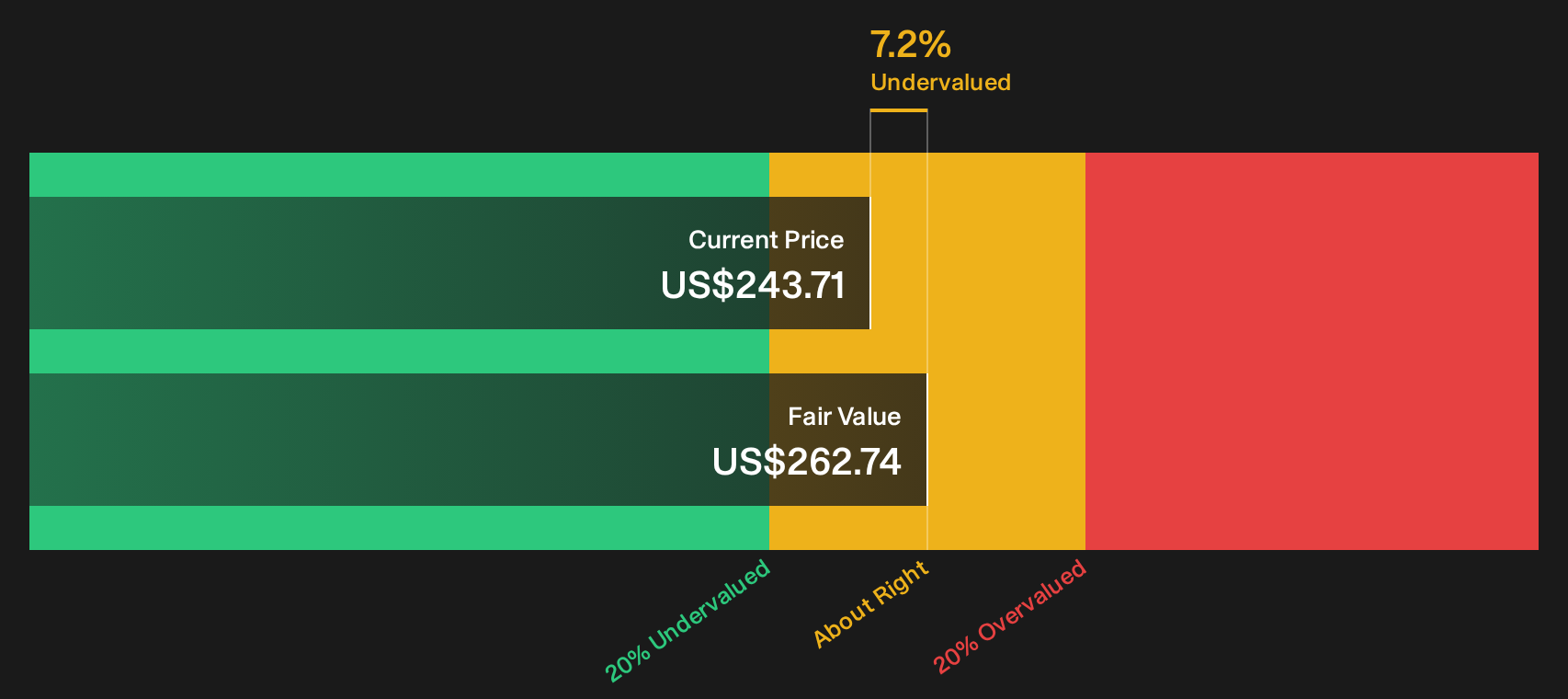
Simply Wall St performs a discounted cash flow (DCF) on every stock in the world every day (check out Erie Indemnity for example). We show the entire calculation in full. You can track the result in your watchlist or portfolio and be alerted when this changes, or use our stock screener to discover 58 high quality undervalued stocks. If you save a screener we even alert you when new companies match - so you never miss a potential opportunity.
Next Steps
If the mixed signals here leave you unsure, that is the point. Use the full set of fundamentals to stress test your own view and then weigh the 2 key rewards
Looking for more investment ideas?
If Erie Indemnity sits on your watchlist but you want more options, broaden your search with other stocks that fit different risk and return profiles.
- Target potential value opportunities by scanning companies that screen as 58 high quality undervalued stocks and see which ones deserve a closer look.
- Strengthen your income focus by reviewing businesses that currently show up as 13 dividend fortresses and may appeal if regular payouts matter to you.
- Lower the stress in your portfolio by concentrating on companies that qualify as 68 resilient stocks with low risk scores and could help balance more volatile positions.
This article by Simply Wall St is general in nature. We provide commentary based on historical data and analyst forecasts only using an unbiased methodology and our articles are not intended to be financial advice. It does not constitute a recommendation to buy or sell any stock, and does not take account of your objectives, or your financial situation. We aim to bring you long-term focused analysis driven by fundamental data. Note that our analysis may not factor in the latest price-sensitive company announcements or qualitative material. Simply Wall St has no position in any stocks mentioned.
Have feedback on this article? Concerned about the content? Get in touch with us directly. Alternatively, email editorial-team@simplywallst.com