


- Are you wondering whether Walmart's strong share price run still leaves room for value, or if you may be late to the story?
- Walmart's stock closed at US$126.79, with returns of 2.7% over 7 days, 2.4% over 30 days, 12.4% year to date, 52.6% over 1 year, 161.6% over 3 years and 190.6% over 5 years, which gives plenty of context for thinking about what you are paying today.
- Recent coverage has focused on Walmart's scale in US consumer retailing, its position in everyday essentials and the broader conversation around how large retailers are managing costs and pricing. These themes provide helpful context when you consider why the market is pricing the stock where it is now.
- Despite that track record, Walmart currently scores 0 out of 6 on a simple undervaluation checklist. The next sections will walk through different valuation approaches and then finish with a way to think about value that goes beyond just the headline numbers.
Walmart scores just 0/6 on our valuation checks. See what other red flags we found in the full valuation breakdown.
Approach 1: Walmart Discounted Cash Flow (DCF) Analysis
A Discounted Cash Flow, or DCF, model takes estimates of the cash Walmart could generate in the future and discounts those back to what they are worth today, using a required rate of return. It is essentially asking what a rational buyer might pay today for the stream of future cash flows.
For Walmart, the model uses last twelve months free cash flow of about $16.76b, then projects this forward using analyst estimates for the next few years and extrapolated values after that. By 2035, the projection used in this model is free cash flow of $53.82b, based on a 2 Stage Free Cash Flow to Equity approach and a set of discount rates applied to each year.
When all those discounted cash flows are added up, the estimated intrinsic value comes out at about $124.94 per share, compared with the recent share price of $126.79. That implies the stock is around 1.5% above this DCF estimate, which is effectively a small premium rather than a clear bargain or a clear concern.
Result: ABOUT RIGHT
Walmart is fairly valued according to our Discounted Cash Flow (DCF), but this can change at a moment's notice. Track the value in your watchlist or portfolio and be alerted on when to act.
Approach 2: Walmart Price vs Earnings
P/E ratios are a common way to value profitable companies because they link what you pay per share to the earnings that each share generates. A higher P/E usually reflects higher market expectations for future earnings or a perception of lower risk, while a lower P/E can signal lower growth expectations or higher risk.
For Walmart, the current P/E is 46.17x. This sits well above the Consumer Retailing industry average P/E of 18.66x and also above the peer group average of 25.97x. On simple comparisons, the market is placing a much higher multiple on Walmart's earnings than on many of its industry peers.
Simply Wall St's Fair Ratio framework estimates what a more tailored P/E might look like after factoring in Walmart's earnings growth profile, profit margins, size, industry and risk characteristics. This Fair Ratio for Walmart is 40.42x. It is designed to be more specific than a broad industry or peer average because it adjusts for company level differences rather than treating all retailers the same.
Comparing the current P/E of 46.17x with the Fair Ratio of 40.42x suggests the shares trade above this tailored benchmark, which points to a valuation that is richer than the model implies.
Result: OVERVALUED

P/E ratios tell one story, but what if the real opportunity lies elsewhere? Start investing in legacies, not executives. Discover our 20 top founder-led companies.
Upgrade Your Decision Making: Choose your Walmart Narrative
Earlier it was mentioned that there is an even better way to understand valuation. This is where Narratives come in, giving you a simple way to attach a clear story about Walmart, including your view on its future revenue, earnings and margins, to a set of numbers that roll up into a Fair Value. On Simply Wall St, Narratives live in the Community page and are designed so any investor can quickly set their assumptions, see a forecast, and then compare that Fair Value with Walmart’s current share price to help decide whether it looks closer to a buy, a hold, or a sell for their own approach. Narratives are not static; they update as fresh information like earnings, news or guidance is added, so your story and numbers stay in sync with what is happening at the company. For Walmart, one investor might build a Narrative similar to the higher analyst case, using earnings of about US$33.0b and a higher Fair Value. Another might lean toward the lower case that aligns more with a Fair Value around US$71 to US$75 per share, and both can see exactly how their different stories translate into different valuations.
For Walmart, here are previews of two leading Walmart Narratives to make things easier:
Fair value in this narrative: US$136.02 per share
Implied pricing gap versus the latest close: about 6.8% below this fair value estimate
Revenue growth assumption used: 4.7% per year
- Focuses on AI supported commerce, rapid delivery and an omni channel model that ties together stores, apps and e commerce.
- Highlights growth in higher margin areas such as advertising, marketplace services and memberships, along with an expanding international footprint.
- Flags risks around e commerce profitability, tariffs, competition, wage and claims costs, and execution in emerging markets.
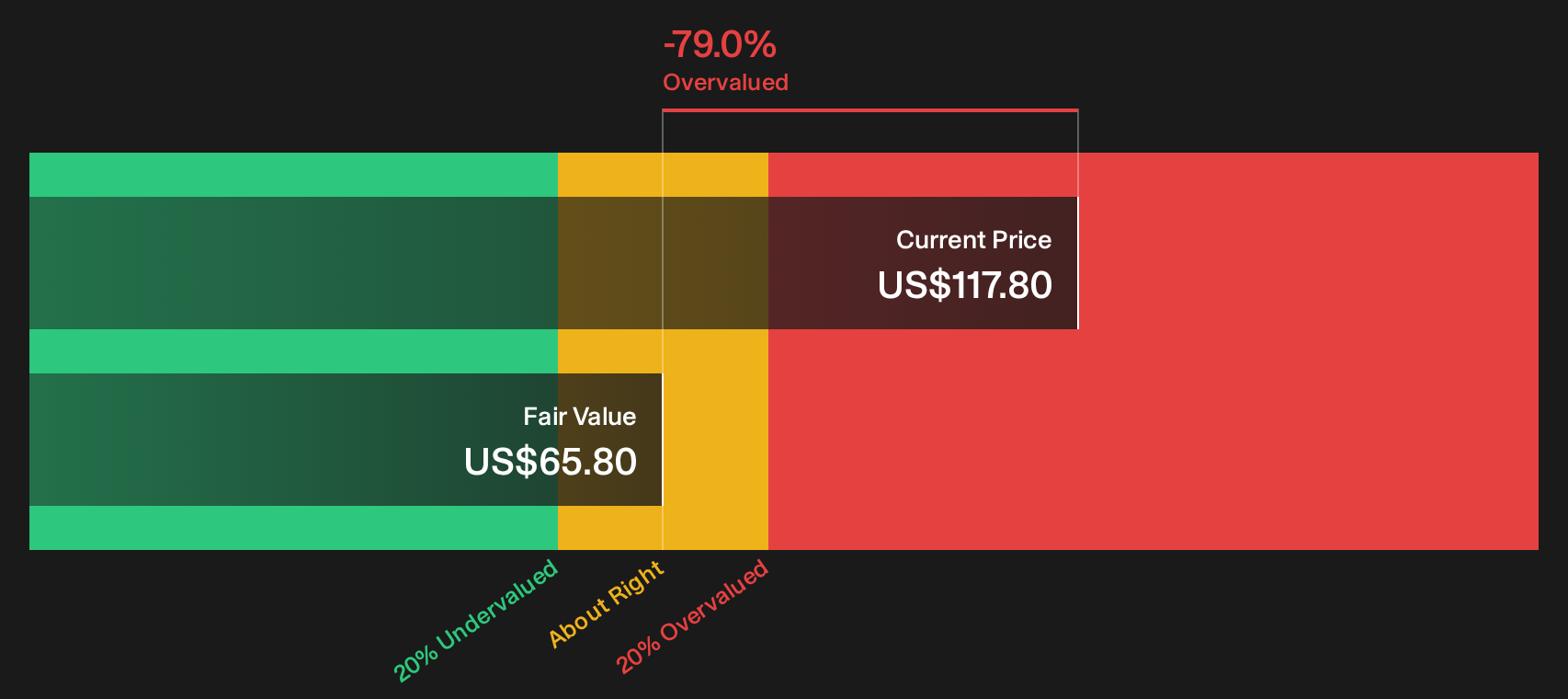
Fair value in this narrative: US$71.70 per share
Implied pricing gap versus the latest close: about 77.0% above this fair value estimate
Revenue growth assumption used: 4.4% per year
- Sees value coming from automation, cost efficiencies, cloud and digital infrastructure, and expansion in China and India.
- Applies more conservative assumptions to margins, growth and the future P/E multiple, which leads to a lower fair value estimate.
- Stresses risks such as labor costs, competition from other large retailers, execution of automation, international exposure and supply chain disruption.
To see how these numbers and stories look when fully built out into detailed forecasts, head over to the Walmart Community page and read the Narratives in full for yourself, then decide which version feels closest to how you see the company.
Do you think there's more to the story for Walmart? Head over to our Community to see what others are saying!

This article by Simply Wall St is general in nature. We provide commentary based on historical data and analyst forecasts only using an unbiased methodology and our articles are not intended to be financial advice. It does not constitute a recommendation to buy or sell any stock, and does not take account of your objectives, or your financial situation. We aim to bring you long-term focused analysis driven by fundamental data. Note that our analysis may not factor in the latest price-sensitive company announcements or qualitative material. Simply Wall St has no position in any stocks mentioned.
Have feedback on this article? Concerned about the content? Get in touch with us directly. Alternatively, email editorial-team@simplywallst.com