


- Investors may be wondering whether Gartner, at around US$148.67, is starting to look interesting again or if the risks still outweigh the potential reward.
- The stock has had a tough run, with the share price down 6.1% over the last week, 12.0% over the last month, 37.3% year to date and 60.6% over the past year. This has contributed to weaker 3 year and 5 year returns of 53.0% and 21.4% respectively.
- Recent attention around Gartner has focused on its position as a key research and advisory provider for technology and business leaders, and how that role fits into changing priorities for IT and enterprise spending. Ongoing discussion has also centered on how investors weigh that role against prolonged share price weakness.
- Gartner currently has a valuation score of 4 out of 6, which suggests some of the standard checks point to undervaluation. The next step is to look more closely at how different valuation methods line up for the stock and why a broader valuation framework at the end of this article may provide an even clearer picture.
Find out why Gartner's -60.6% return over the last year is lagging behind its peers.
Approach 1: Gartner Discounted Cash Flow (DCF) Analysis
A Discounted Cash Flow model takes estimates of a company’s future cash flows, then discounts them back to today using a required rate of return to arrive at an estimate of intrinsic value per share.
For Gartner, the model used is a 2 Stage Free Cash Flow to Equity approach. The latest twelve month Free Cash Flow stands at about $1.18b. Analyst and extrapolated projections, provided by Simply Wall St, show Free Cash Flow estimates such as $1,164.6m in 2026 and $1,409.2m in 2028, extending out to an extrapolated $1,887.7m in 2035. These are all assessed in dollars and discounted back to today to estimate what that future stream could be worth now.
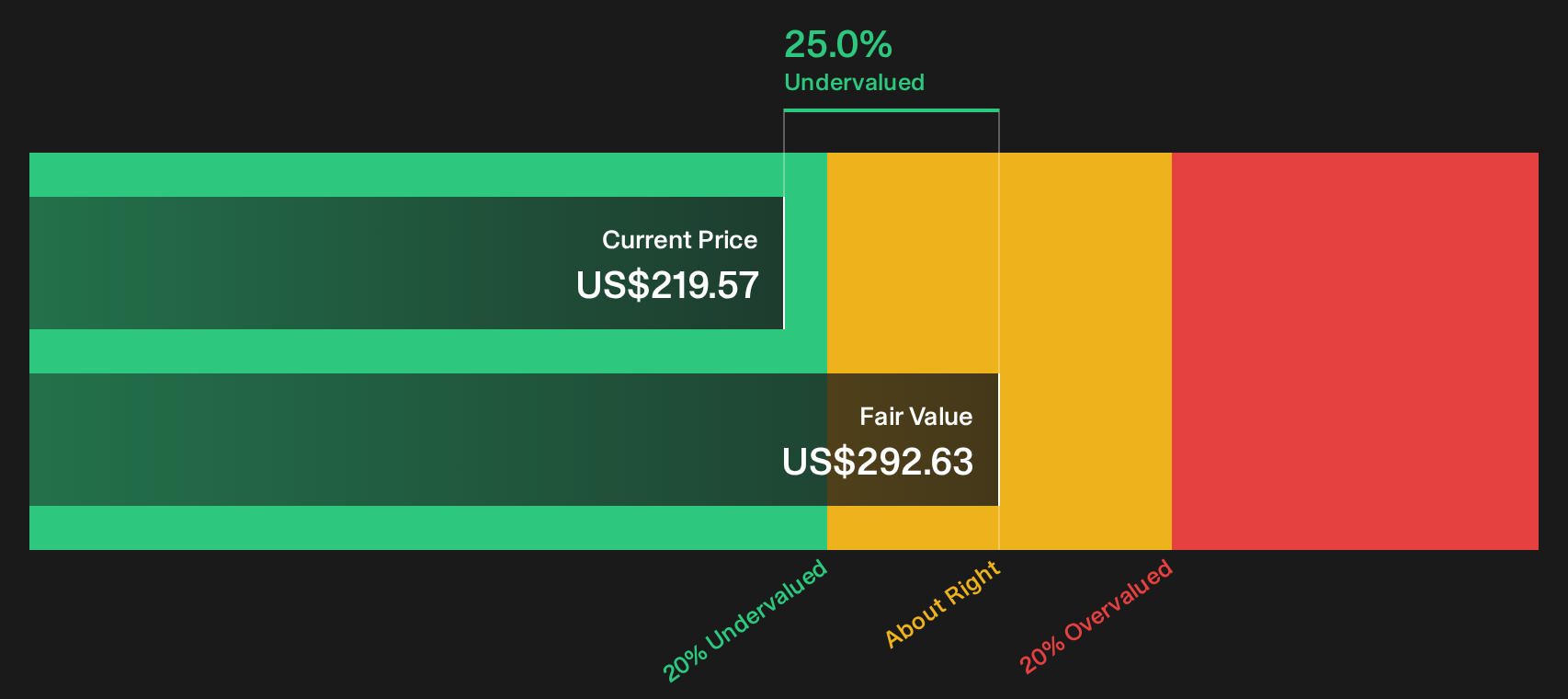
On this basis, the DCF model suggests an intrinsic value of about $300.31 per share, compared with a current share price of $148.67. That implies an intrinsic discount of roughly 50.5%, which indicates the model points to the shares trading well below this estimate of fair value.
Result: UNDERVALUED
Our Discounted Cash Flow (DCF) analysis suggests Gartner is undervalued by 50.5%. Track this in your watchlist or portfolio, or discover 61 more high quality undervalued stocks.
Approach 2: Gartner Price vs Earnings
For profitable companies, the P/E ratio is often a useful shorthand because it links what you pay for each share to the earnings that support that share price. It helps you quickly see how much investors are paying for each dollar of current earnings.
What counts as a “normal” or “fair” P/E usually reflects a mix of growth expectations and risk. Higher expected earnings growth or lower perceived risk can justify a higher multiple, while slower growth or higher risk tends to point to a lower one.
Gartner currently trades on a P/E of 14.36x, which is close to the peer average of 14.17x and below the broader IT industry average of 19.75x. Simply Wall St’s Fair Ratio for Gartner is 27.46x, which is a proprietary estimate of what the P/E might be given factors such as earnings growth, industry, profit margins, market cap and risk profile. This Fair Ratio can be more informative than a simple peer or industry comparison because it adjusts for company specific characteristics instead of treating all IT stocks as alike.
Comparing Gartner’s current P/E of 14.36x with the Fair Ratio of 27.46x suggests the shares are trading below this tailored benchmark.
Result: UNDERVALUED

P/E ratios tell one story, but what if the real opportunity lies elsewhere? Start investing in legacies, not executives. Discover our 18 top founder-led companies.
Upgrade Your Decision Making: Choose your Gartner Narrative
Earlier it was mentioned that there is an even better way to understand valuation, so Narratives are introduced here as a simple way for you to attach a clear story about Gartner to your numbers by linking your view on its future revenue, earnings and margins to a financial forecast and then to a Fair Value that can be compared with the current share price.
On Simply Wall St’s Community page, Narratives are available as an easy tool used by millions of investors, allowing you to pick or adapt a storyline that fits your view. For example, you might consider a cautious case where Fair Value sits around US$140.00, or a more optimistic case closer to US$252.78 or US$190.46, and then see at a glance whether your chosen Fair Value is above or below the current price.
Because these Narratives are updated when new information such as news, buyback announcements or earnings arrives, you can see how a more pessimistic Gartner story that focuses on lawsuit risks and modest revenue growth, or a more upbeat story that centers on expanded buybacks and AI tools like AskGartner, flows directly into different forecasts and Fair Values for you to consider when making timing decisions.
For Gartner, however, we will make it really easy for you with previews of two leading Gartner Narratives:
Fair Value: US$190.46
Implied discount vs current price: ((190.46 - 148.67) / 190.46) ≈ 21.9% undervalued
Revenue growth assumption: 3.74%
- Analysts see steady revenue growth and modest margin expansion, supported by demand for guidance on AI, digital transformation and complex IT decisions.
- Strong free cash flow and ongoing buybacks are central to the view that earnings per share can keep rising even if top line growth is moderate.
- Key watchpoints include the impact of generative AI on research demand, procurement pressure at large clients and the resilience of Gartner's subscription model.
Fair Value: US$140.00
Implied premium vs current price: ((148.67 - 140.00) / 140.00) ≈ 6.2% overvalued
Revenue growth assumption: 1.03%
- Bearish analysts focus on the risk that free or low cost AI tools and in house analytics chip away at Gartner's data advantage and pricing power.
- They highlight exposure to large enterprise and government clients with tighter budgets and long approval cycles, which could add volatility to revenue.
- In this view, high fixed costs and intensifying competition justify a lower P/E multiple, even if earnings continue to grow over time.
If you want to see how other investors are weighing these storylines against the current share price, you can review the full narrative range and stress test which assumptions feel closest to your own.
To see how these results tie into long-term growth, risks, and valuation, check out the full range of community narratives for Gartner on Simply Wall St. Add the company to your watchlist or portfolio so you'll be alerted when the story evolves.
Do you think there's more to the story for Gartner? Head over to our Community to see what others are saying!

This article by Simply Wall St is general in nature. We provide commentary based on historical data and analyst forecasts only using an unbiased methodology and our articles are not intended to be financial advice. It does not constitute a recommendation to buy or sell any stock, and does not take account of your objectives, or your financial situation. We aim to bring you long-term focused analysis driven by fundamental data. Note that our analysis may not factor in the latest price-sensitive company announcements or qualitative material. Simply Wall St has no position in any stocks mentioned.
Have feedback on this article? Concerned about the content? Get in touch with us directly. Alternatively, email editorial-team@simplywallst.com