


- In early April 2026, United Airlines Holdings, Inc. faced investor activism as shareholder John Chevedden submitted a proposal to allow action by written consent, while the company simultaneously urged investors to vote against it ahead of the May 19, 2026 annual meeting.
- At the same time, United advanced a premium-focused transformation that includes a tentative industry-leading flight attendant agreement, higher checked-bag fees, and new premium fare tiers, reshaping how it balances costs, labor relations, and higher-yield revenue.
- We’ll now consider how United’s push into premium offerings and fee adjustments may influence its existing investment narrative and assumptions.
Invest in the nuclear renaissance through our list of 93 elite nuclear energy infrastructure plays powering the global AI revolution.
United Airlines Holdings Investment Narrative Recap
To own United today, you need to believe its premium focused transformation and fleet investments can offset high debt and structurally uncertain business travel. The latest push into higher bag fees and premium fare tiers supports that thesis, while the written consent fight highlights governance friction. Near term, the key catalyst is execution on premium revenue and cost control; the most immediate risk remains elevated leverage combined with rising labor and fuel costs.
The tentative flight attendant agreement is especially relevant here. It directly affects United’s cost base and labor stability at the same time it is trying to extract more revenue from premium cabins and ancillary fees. If ratified, higher wages and a US$740,000,000 signing bonus would test how far the premium and fee strategy can go in supporting margins, and how much flexibility United really has around its largest variable cost.
Yet, while premium investments look attractive on the surface, investors should be aware that rising labor, fuel and debt costs could still...
Read the full narrative on United Airlines Holdings (it's free!)
United Airlines Holdings' narrative projects $72.0 billion revenue and $4.7 billion earnings by 2029. This requires 6.8% yearly revenue growth and about a $1.3 billion earnings increase from $3.4 billion today.
Uncover how United Airlines Holdings' forecasts yield a $132.67 fair value, a 36% upside to its current price.
Exploring Other Perspectives
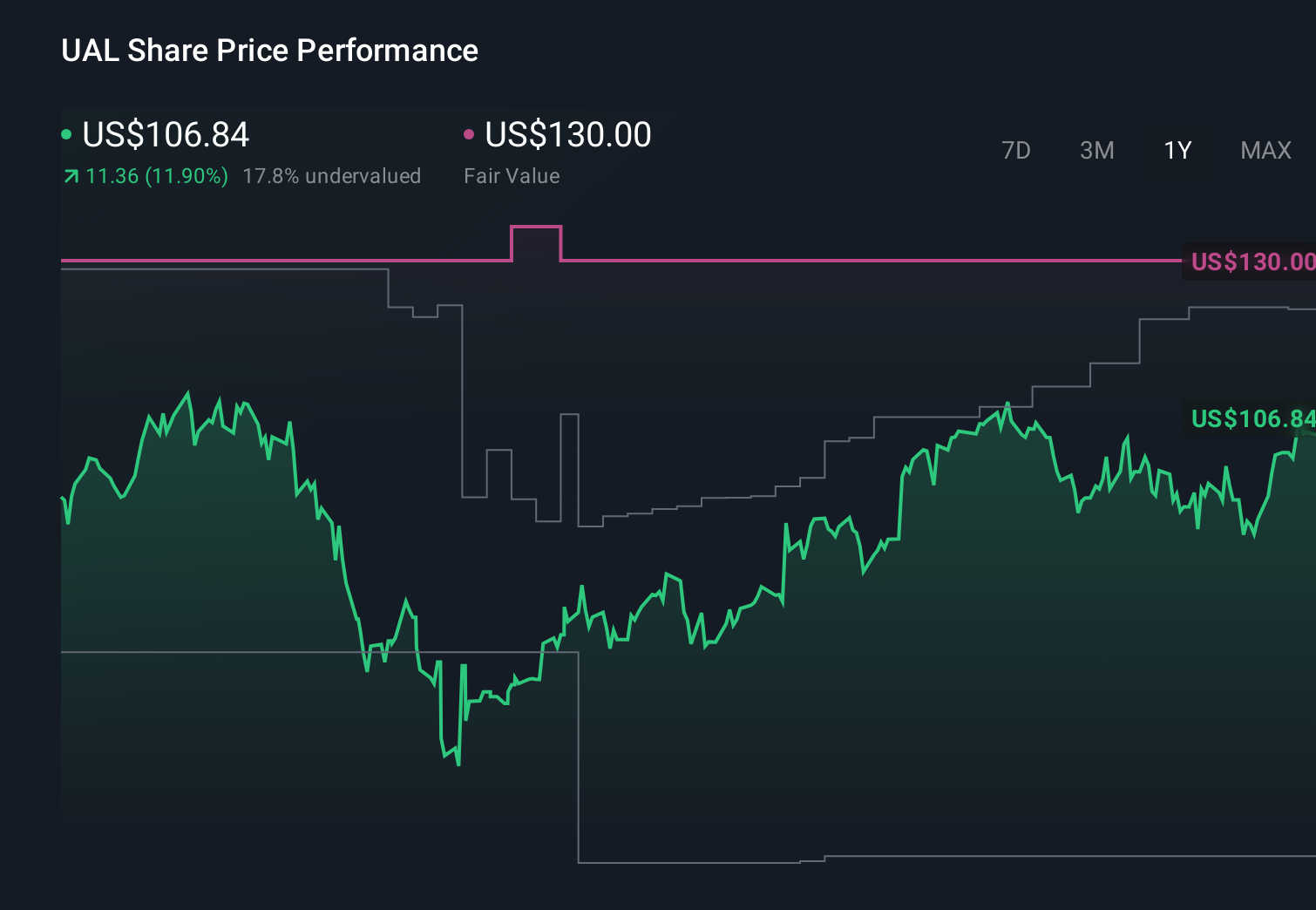
Some of the lowest analysts sounded far more cautious, even before this news, expecting revenue to reach about US$64,200,000,000 and earnings around US$3,700,000,000 by 2028, which could make the current optimism around premium expansion and governance debates look ambitious if costs or demand shift again.
Explore 4 other fair value estimates on United Airlines Holdings - why the stock might be worth over 2x more than the current price!
Form Your Own Verdict
Disagree with existing narratives? Extraordinary investment returns rarely come from following the herd, so go with your instincts.
- A great starting point for your United Airlines Holdings research is our analysis highlighting 4 key rewards and 2 important warning signs that could impact your investment decision.
- Our free United Airlines Holdings research report provides a comprehensive fundamental analysis summarized in a single visual - the Snowflake - making it easy to evaluate United Airlines Holdings' overall financial health at a glance.
Curious About Other Options?
Don't miss your shot at the next 10-bagger. Our latest stock picks just dropped:
- Capitalize on the AI infrastructure supercycle with our selection of the 36 best 'picks and shovels' of the AI gold rush converting record-breaking demand into massive cash flow.
- The future of work is here. Discover the 33 top robotics and automation stocks leading the charge in AI-driven automation and industrial transformation.
- Explore 24 top quantum computing companies leading the revolution in next-gen technology and shaping the future with breakthroughs in quantum algorithms, superconducting qubits, and cutting-edge research.
This article by Simply Wall St is general in nature. We provide commentary based on historical data and analyst forecasts only using an unbiased methodology and our articles are not intended to be financial advice. It does not constitute a recommendation to buy or sell any stock, and does not take account of your objectives, or your financial situation. We aim to bring you long-term focused analysis driven by fundamental data. Note that our analysis may not factor in the latest price-sensitive company announcements or qualitative material. Simply Wall St has no position in any stocks mentioned.
Have feedback on this article? Concerned about the content? Get in touch with us directly. Alternatively, email editorial-team@simplywallst.com