


- Wondering whether Amgen at around US$351 per share still offers value, or if most of the opportunity is already priced in.
- The stock has returned 0.9% over the past week, 7.1% year to date, and 26.6% over the last year, with a 4.6% decline across the past month that may have shifted how some investors think about its risk and return profile.
- Recent headlines have focused on Amgen's position within the large cap biotech space, including ongoing attention on its product portfolio and pipeline as key drivers of sentiment. These updates help explain why the share price has seen both periods of strength over 1, 3 and 5 years, and shorter term pullbacks like the recent 30 day move.
- Amgen currently scores a value check of 4 out of 6. This sets up a closer look at how different methods like P/E multiples and discounted cash flow compare, and why a broader framework for understanding valuation can be even more useful by the end of this article.
Find out why Amgen's 26.6% return over the last year is lagging behind its peers.
Approach 1: Amgen Discounted Cash Flow (DCF) Analysis
A Discounted Cash Flow, or DCF, model estimates what a company could be worth by projecting its future cash flows and then discounting them back to today using a required rate of return. It is essentially asking what those future dollars are worth in present terms.
For Amgen, the model used is a 2 Stage Free Cash Flow to Equity approach. The latest twelve month free cash flow is about $8.4b. Analyst and extrapolated projections suggest free cash flow of around $13.6b in 2026 and $16.2b by 2030, with further estimates extending out to 2035, all expressed in US$.
When those projected cash flows are discounted back to today and aggregated, the DCF model points to an estimated intrinsic value of about $650.20 per share. Compared with a current share price around $351, this framework implies the stock trades at roughly a 46.0% discount to that intrinsic value, which the model interprets as meaningfully undervalued on these cash flow assumptions.
Result: UNDERVALUED
Our Discounted Cash Flow (DCF) analysis suggests Amgen is undervalued by 46.0%. Track this in your watchlist or portfolio, or discover 59 more high quality undervalued stocks.

Approach 2: Amgen Price vs Earnings (P/E)
For a profitable company like Amgen, the P/E ratio is a useful way to relate what you pay for each share to the earnings that support it. Investors often pay higher P/E multiples when they expect stronger growth or see lower risk, and lower P/E multiples when they see weaker growth or higher uncertainty, so what counts as a “normal” P/E is rarely one size fits all.
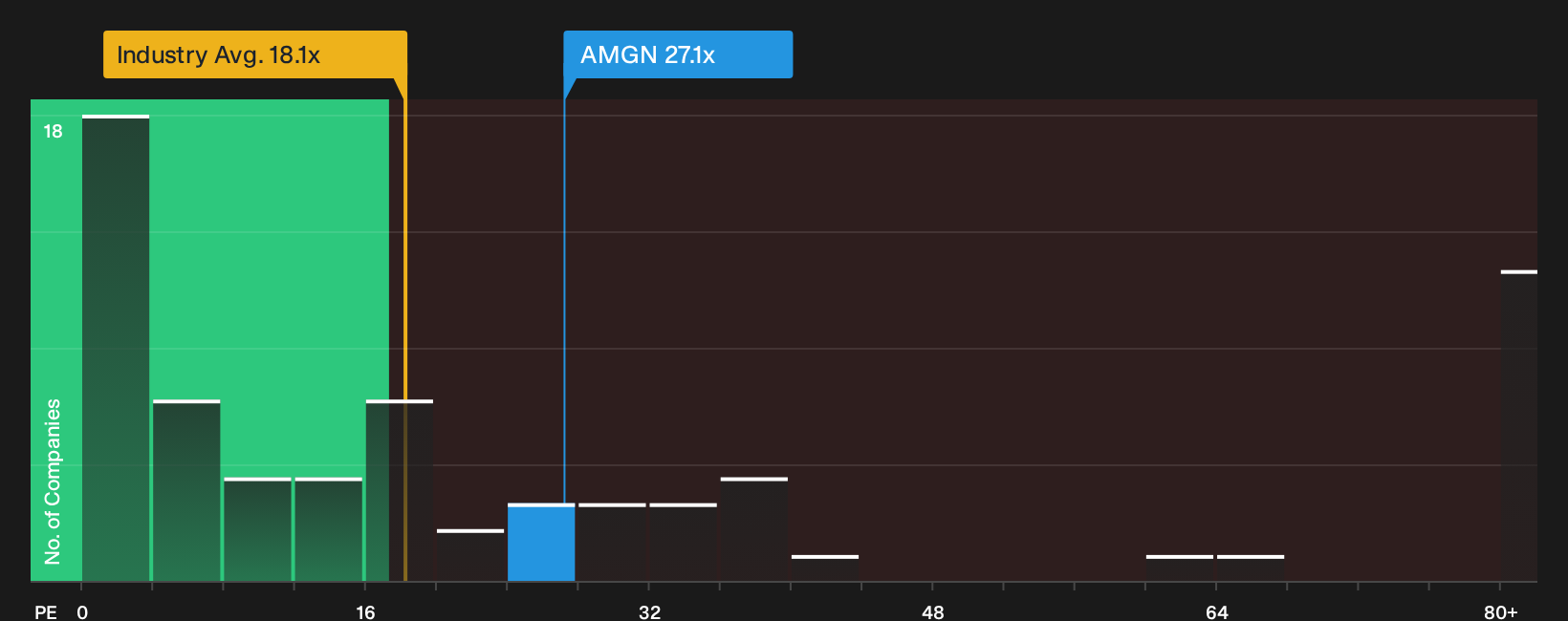
Amgen currently trades on a P/E of 24.6x. That sits above the Biotechs industry average of 18.1x, but below the peer group average of 38.3x. To put those comparisons into better context, Simply Wall St also calculates a “Fair Ratio” for Amgen of 26.3x. This is a proprietary view of what Amgen’s P/E might be given factors such as its earnings growth profile, industry, profit margins, market cap and company specific risks.
Because the Fair Ratio is tailored to Amgen’s characteristics, it can be more informative than a simple comparison with broad industry or peer averages. With the current P/E of 24.6x sitting below the Fair Ratio of 26.3x, this approach points to Amgen trading at a discount on this metric.
Result: UNDERVALUED
P/E ratios tell one story, but what if the real opportunity lies elsewhere? Start investing in legacies, not executives. Discover our 19 top founder-led companies.
Upgrade Your Decision Making: Choose your Amgen Narrative
Earlier it was mentioned that there is an even better way to understand valuation, so Narratives are introduced here as a simple tool that lets you attach a clear story about Amgen to the numbers behind your fair value, including your expectations for future revenue, earnings and margins. You can then link that story to a forecast and a fair value you can compare against the current share price.
On Simply Wall St's Community page, Narratives are available to millions of investors and are updated automatically when new information such as news, filings or earnings is added. This means the fair value that comes from each story stays aligned with the latest data rather than staying fixed to an old model.
For Amgen, one investor might build a Narrative that looks closer to the bullish fair value of about US$432 per share, built on assumptions such as revenue of US$44.4b, earnings of US$13.1b and a P/E of 22.3x around 2029. Another might lean toward a more cautious fair value closer to US$218.89 with revenues of US$34.4b, earnings of US$5.2b and a P/E of 27.9x. By comparing each fair value to the current price you can decide whether those stories suggest Amgen is trading above or below what you think it is worth.
For Amgen however, we will make it really easy for you with previews of two leading Amgen Narratives:
These are not buy or sell calls. They are structured stories that show what would need to be true for Amgen to look attractively priced or fully priced at around US$351 per share, using the same building blocks you have already seen, such as revenue, margins, P/E and discount rates.
Fair value in this bullish narrative: US$432.00 per share
Gap to that fair value at the last close of US$351.02: about 18.8% below the narrative fair value
Revenue growth used in this narrative: 6.48% a year
- Assumes obesity and cardiovascular drugs, along with a wide late stage pipeline, support higher revenue and cash generation, with scope for margins to move from 21.0% to 29.6% over the next few years.
- Builds in ongoing benefits from AI supported R&D, a broad global footprint and potential M&A, which together allow Amgen to keep launching new products while managing pricing and payer pressure.
- Accepts meaningful risks around drug pricing policy, patent expiries, biosimilar competition and acquisition integration. This narrative still concludes that US$432 is a reasonable anchor if earnings and margins track the higher end of current expectations.
Fair value in this more cautious narrative: US$350.03 per share
Gap to that fair value at the last close of US$351.02: about 0.3% above the narrative fair value
Revenue growth used in this narrative: 2.67% a year
- Assumes steadier progress, with revenue growth of a few percent a year and profit margins rising from 19.0% to about 24.0%, as existing products and late stage drugs like MariTide and cardiovascular assets support earnings but do not radically change the profile.
- Places more weight on pricing pressure, patent expiries and biosimilar competition over the next decade, along with higher ongoing R&D and manufacturing spend, which could limit how much free cash flow expands.
- Arrives at a fair value close to current trading levels. For this story to hold, you would need to be comfortable with a future P/E of around 24.7x and moderate growth in exchange for the risks around regulation, competition and long dated pipeline outcomes.
If you want to see how other investors frame the trade off between these kinds of bullish and cautious cases, and how that feeds into different fair values over time, See what the community is saying about Amgen
Do you think there's more to the story for Amgen? Head over to our Community to see what others are saying!

This article by Simply Wall St is general in nature. We provide commentary based on historical data and analyst forecasts only using an unbiased methodology and our articles are not intended to be financial advice. It does not constitute a recommendation to buy or sell any stock, and does not take account of your objectives, or your financial situation. We aim to bring you long-term focused analysis driven by fundamental data. Note that our analysis may not factor in the latest price-sensitive company announcements or qualitative material. Simply Wall St has no position in any stocks mentioned.
Have feedback on this article? Concerned about the content? Get in touch with us directly. Alternatively, email editorial-team@simplywallst.com