


American Airlines Group (AAL) stock has been moving on two fronts: easing U.S.-Iran tensions that pulled oil prices lower, and a fresh hike in checked bag fees aimed at offsetting still elevated fuel costs.
See our latest analysis for American Airlines Group.
At a share price of $11.32, American Airlines has a 7 day share price return of 4.43% and a 30 day share price return of 2.54%, set against a 90 day share price return decline of 29.21% and a 1 year total shareholder return of 17.06%. This indicates that recent momentum is recovering after a weaker few months as investors reassess fuel costs, fee changes and demand signals.
If you are looking beyond airlines and want more ideas tied to big technology shifts, this could be a good moment to scan 36 AI infrastructure stocks
With American trading at $11.32 and screens flagging an intrinsic discount of about 21%, investors are weighing improved sentiment and fee moves against mixed long term returns. The key question is whether there is still a mispricing here or if future growth is already reflected in the current price.
Most Popular Narrative: 6.7% Overvalued
American Airlines closed at $11.32, while the most followed narrative, with a fair value of $10.61, points to a small premium baked into the price.
There's a single reason why American is the least attractive of US legacy carriers (in terms of investing, anyway): its balance sheet. If most airlines and certainly those in the US are loaded up to the hilt with debt, American goes so far as to boast negative equity. Any startup would go belly-up with a balance sheet such as this one. Now, you can survive and even generate decent returns with a precarious capital structure, but of course you're super-sensitive to any shock on the demand side of your business, hitting both revenues and margins, and that is where the clouds gather on American. After the industry's recent warnings re falling travel demand, the already cut-throat competition for market share will get yet more intensive, while margins will inevitably come under pressure. I fail to see why American might be an attractive investment proposition outside of the rosiest of economic outlooks, which is not what's at hand right now.
According to PittTheYounger, this valuation leans heavily on how fast earnings can compound, how much revenue can steadily build, and where margins settle once the cycle turns.
Result: Fair Value of $10.61 (OVERVALUED)
Have a read of the narrative in full and understand what's behind the forecasts.
However, a weaker travel backdrop or tougher refinancing terms could quickly squeeze margins and make that current premium to fair value look fragile.
Find out about the key risks to this American Airlines Group narrative.
Another View: Cash Flows Paint a Different Picture
While the most followed narrative suggests American Airlines is about 6.7% overvalued at $11.32, our DCF model points the other way. On that approach, the stock screens as undervalued, with the current price about 21.2% below an estimated fair value of $14.36.
This gap between a premium on the narrative fair value of $10.61 and a discount to the DCF fair value of $14.36 raises a practical question for you as an investor: which set of assumptions on cash flows and risk feels closer to reality?
Look into how the SWS DCF model arrives at its fair value.
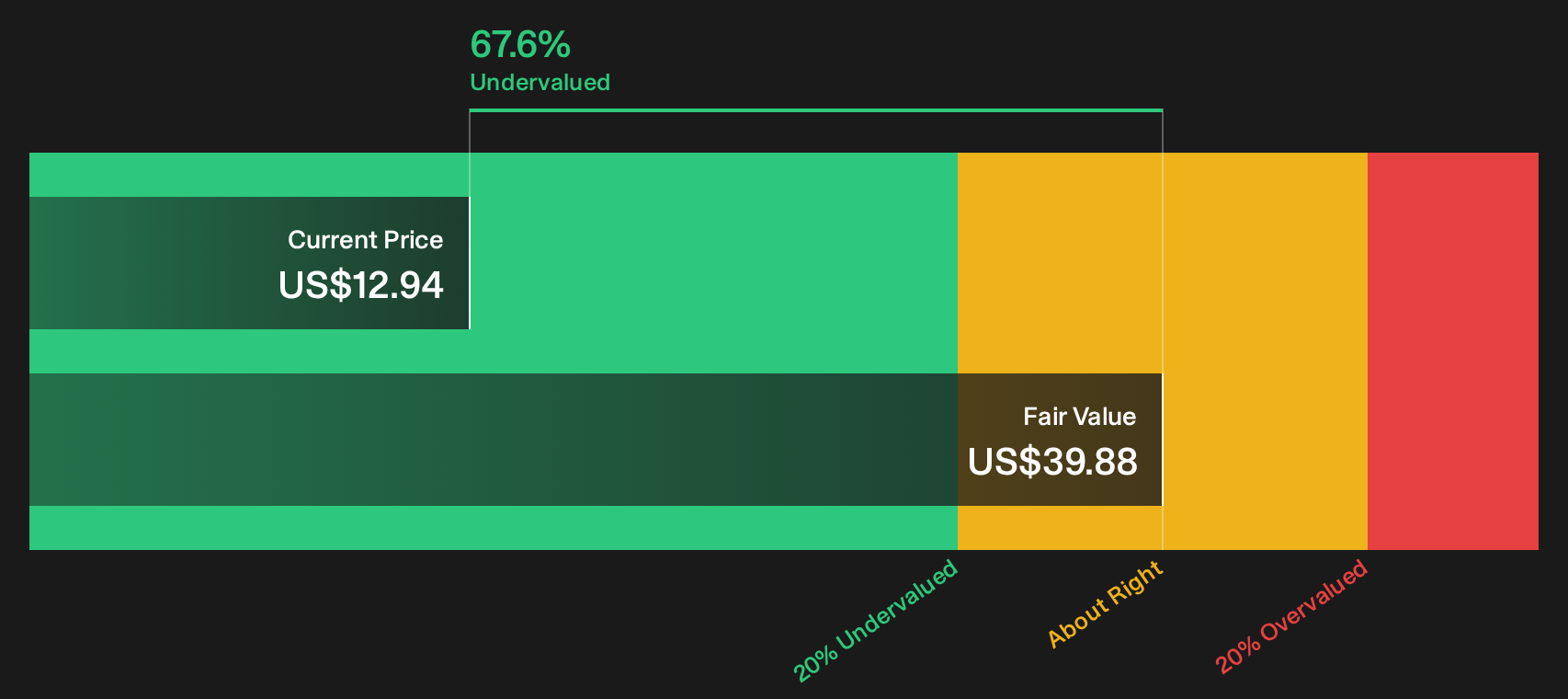
Simply Wall St performs a discounted cash flow (DCF) on every stock in the world every day (check out American Airlines Group for example). We show the entire calculation in full. You can track the result in your watchlist or portfolio and be alerted when this changes, or use our stock screener to discover 58 high quality undervalued stocks. If you save a screener we even alert you when new companies match - so you never miss a potential opportunity.
Next Steps
With sentiment clearly split between risk and reward, this is a moment to move quickly, review the numbers yourself, and weigh up 2 key rewards and 4 important warning signs
Looking for more investment ideas?
If you want to keep your edge, do not stop at one stock. Use the Simply Wall St screener to surface fresh ideas that match your priorities.
- Target resilient income by checking out companies that currently yield over 5% and feature strong payout profiles through the 11 dividend fortresses.
- Hunt for quality at a discount by scanning companies that pair solid fundamentals with attractive pricing using the screener containing 23 high quality undiscovered gems.
- Reduce portfolio stress by focusing on businesses with steadier risk profiles and robust fundamentals through the 72 resilient stocks with low risk scores.
This article by Simply Wall St is general in nature. We provide commentary based on historical data and analyst forecasts only using an unbiased methodology and our articles are not intended to be financial advice. It does not constitute a recommendation to buy or sell any stock, and does not take account of your objectives, or your financial situation. We aim to bring you long-term focused analysis driven by fundamental data. Note that our analysis may not factor in the latest price-sensitive company announcements or qualitative material. Simply Wall St has no position in any stocks mentioned.
Have feedback on this article? Concerned about the content? Get in touch with us directly. Alternatively, email editorial-team@simplywallst.com