


- In mid-April 2026, Jefferies Financial Group Inc. announced and completed several senior unsecured fixed-income offerings, including new 6% notes due 2036 and step-up notes due 2046, alongside recently issued 6–7% callable global MTN bonds maturing between 2033 and 2046.
- This cluster of higher-coupon, long-dated bond issues highlights Jefferies’ active use of the debt capital markets to shape its funding mix and balance-sheet flexibility.
- We’ll now look at how this series of higher-coupon, long-dated senior notes may influence Jefferies Financial Group’s broader investment narrative.
Rare earth metals are the new gold rush. Find out which 31 stocks are leading the charge.
What Is Jefferies Financial Group's Investment Narrative?
For Jefferies, the core equity story still rests on a relatively low earnings multiple, an established investment banking and trading franchise, and a visible capital return program through dividends and buybacks, even after a choppy year-to-date share price. The recent burst of 6–7% long-dated senior unsecured notes slightly tilts the near-term conversation toward funding costs and balance-sheet discipline: higher coupons can pressure interest expense, but they also lock in term funding and may support Jefferies’ ability to underwrite and warehouse risk for clients, especially alongside the expanded SMFG alliance and increased credit lines. At this stage, the new issuance cluster does not look like a thesis-changing event, yet it feeds into existing catalysts around potential corporate activity with SMFG and continued buybacks, while also sharpening a key risk: the need to justify a richer capital structure with solid, consistent profitability.
However, investors should also weigh how rising interest costs could interact with already modest returns on equity. Jefferies Financial Group's shares are on the way up, but could they be overextended? Uncover how much higher they are than fair value.Exploring Other Perspectives
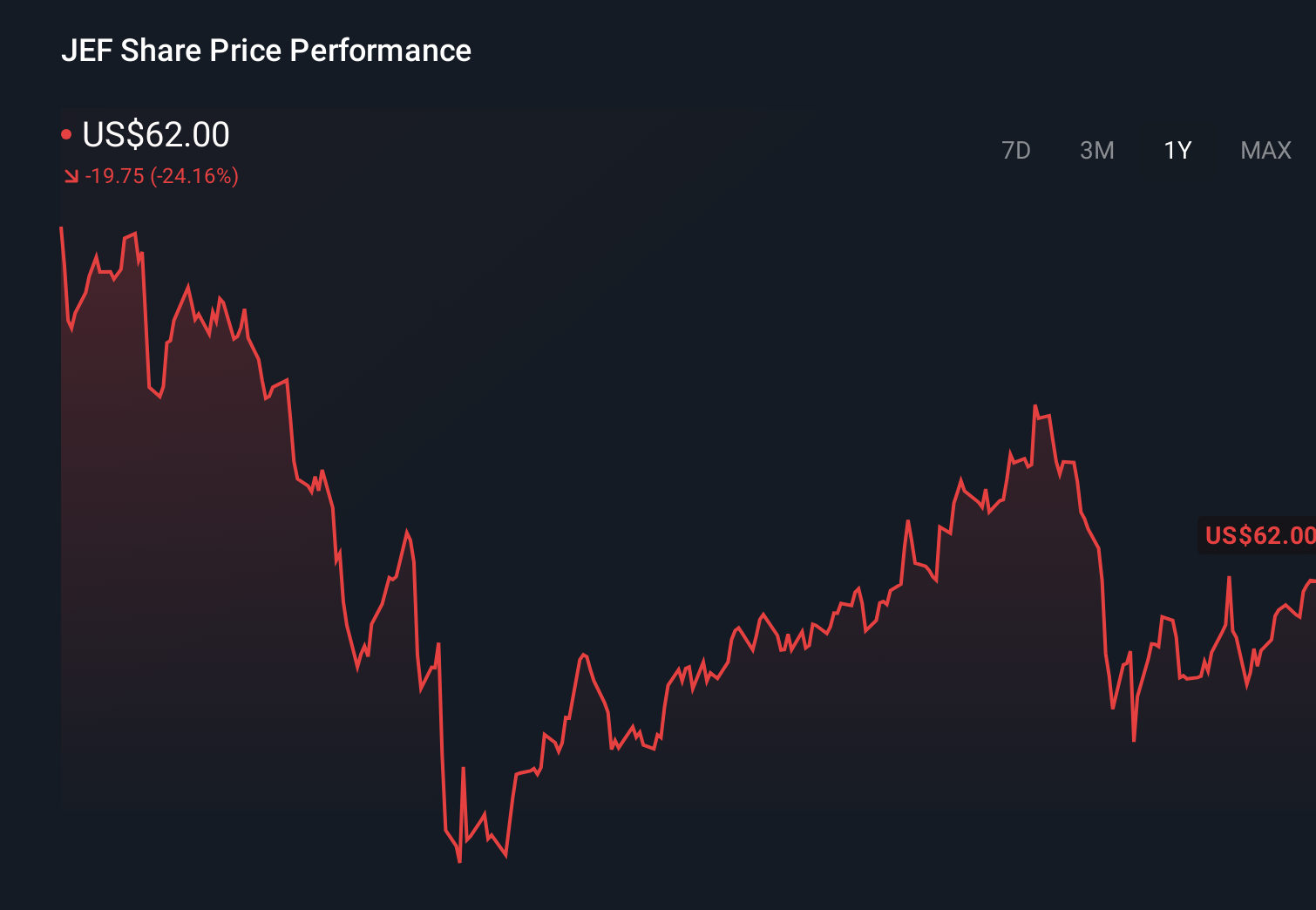
Explore 6 other fair value estimates on Jefferies Financial Group - why the stock might be worth 19% less than the current price!
The Verdict Is Yours
Disagree with this assessment? Extraordinary investment returns rarely come from following the herd, so go with your instincts.
- A great starting point for your Jefferies Financial Group research is our analysis highlighting 3 key rewards and 1 important warning sign that could impact your investment decision.
- Our free Jefferies Financial Group research report provides a comprehensive fundamental analysis summarized in a single visual - the Snowflake - making it easy to evaluate Jefferies Financial Group's overall financial health at a glance.
Interested In Other Possibilities?
Early movers are already taking notice. See the stocks they're targeting before they've flown the coop:
- AI is about to change healthcare. These 35 stocks are working on everything from early diagnostics to drug discovery. The best part - they are all under $10b in market cap - there's still time to get in early.
- Find 58 companies with promising cash flow potential yet trading below their fair value.
- The best AI stocks today may lie beyond giants like Nvidia and Microsoft. Find the next big opportunity with these 19 smaller AI-focused companies with strong growth potential through early-stage innovation in machine learning, automation, and data intelligence that could fund your retirement.
This article by Simply Wall St is general in nature. We provide commentary based on historical data and analyst forecasts only using an unbiased methodology and our articles are not intended to be financial advice. It does not constitute a recommendation to buy or sell any stock, and does not take account of your objectives, or your financial situation. We aim to bring you long-term focused analysis driven by fundamental data. Note that our analysis may not factor in the latest price-sensitive company announcements or qualitative material. Simply Wall St has no position in any stocks mentioned.
Have feedback on this article? Concerned about the content? Get in touch with us directly. Alternatively, email editorial-team@simplywallst.com