


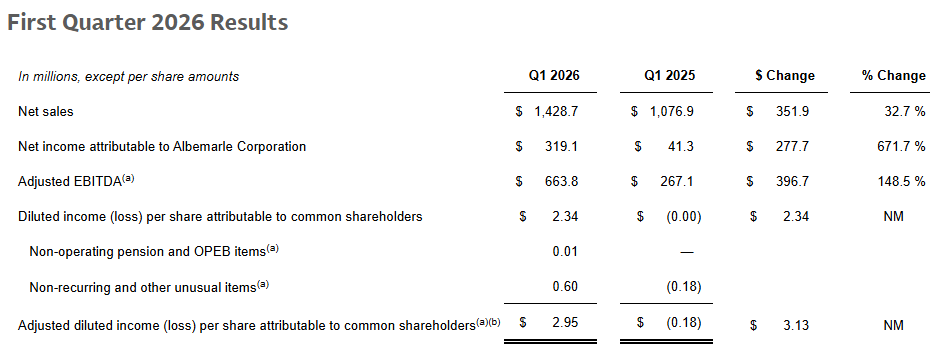
The Zhitong Finance App learned that in the first quarter of 2026, the world's largest lithium producer, American Alb.US (ALB.US), announced that the lithium industry had officially broken out of its trough with a report card far exceeding market expectations. The chemical giant, headquartered in Charlotte, North Carolina, announced that net profit for the first quarter reached US$319.1 million, or US$2.34 per share, compared with only US$49.3 million in the same period last year, which is equivalent to break-even per share. Excluding one-time items, adjusted earnings per share reached $2.95, far higher than LSEG's average analysts' expectations of $1.09.
The revenue side was also strong. Net sales for the first quarter increased 33% year over year to $1.43 billion, slightly higher than analysts' average expectations. Adjusted EBITDA jumped to US$663.8 million, which not only exceeded expectations of US$468.2 million, but also more than doubled from the same period last year, with a year-on-year increase of about 148%.
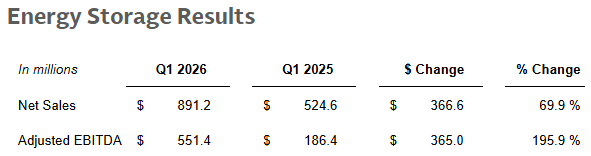
 Judging from the business sector, the lithium business is still the core engine of the performance explosion. The net sales of the energy storage business (that is, the lithium business unit) reached US$891 million, up 70% year on year. Among them, prices rose 51% and sales increased 14%. The adjusted EBITDA for this sector jumped 196% to US$551 million. The specialty chemicals business also grew steadily, with net sales rising 12% to US$358 million and adjusted EBITDA rising 30% to US$76 million.
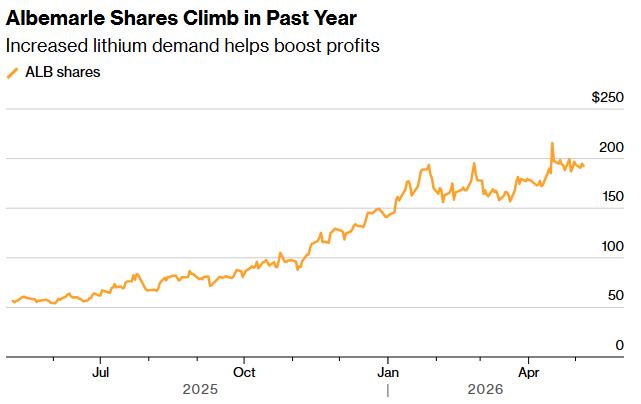
The capital market responded quickly and positively. After the results were announced, Albemarle's stock price rose by about 9% during Wednesday's after-hours trading. Over the past 12 months, the stock has accumulated gains of about 235%, reflecting strong investor bullish sentiment on lithium and energy storage demand.
At the same time, China's lithium mining giants also collectively handed over impressive quarterly reports. Tianqi Lithium's net profit attributable to shareholders of listed companies was about 1,876 billion yuan, an increase of about 16.99 times over the previous year. Ganfeng Lithium's net profit attributable to shareholders of listed companies was about 1,837 billion yuan, reversing losses over the previous year. According to Mysteel statistics from 20 key listed lithium companies, the total net profit for the first quarter reached 16.147 billion yuan. Eighteen companies achieved profits, and 5 companies increased by more than 1000% over the same period last year. This indicates that the entire lithium battery industry chain, from upstream lithium salt to midstream materials to downstream batteries, has achieved comprehensive performance recovery.
Lithium prices soar: supply-side “triple storm”
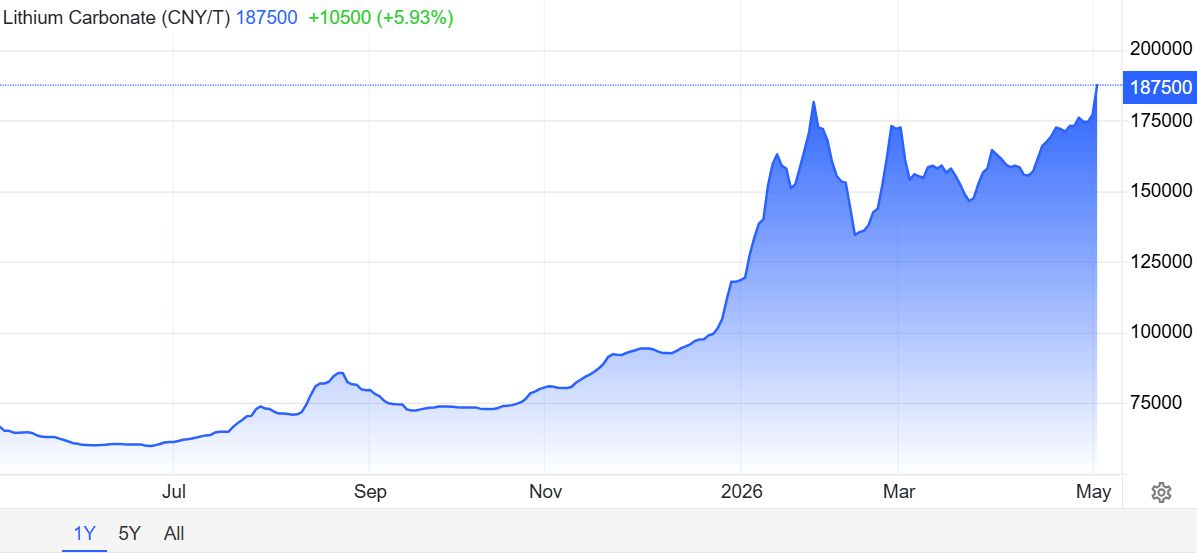
The fundamental driving force behind Abbott's performance explosion is that lithium prices have soared to their highest level in more than two years. Following industry trends, the current market price of battery-grade lithium carbonate in China is about 187,500 yuan per ton, and lithium hydroxide is about 174,500 yuan per ton. International lithium carbonate prices remained near high levels during the year. Lithium carbonate futures have risen 58% year to date.
Supply-side contraction is the core driver of this round of lithium price increases. The three major events during the year had a superposition effect:
First, Zimbabwe imposed a ban on the export of lithium concentrate at the end of February. In 2025, 19% of China's imported lithium concentrate comes from Zimbabwe, and Zimbabwe is expected to account for 12% of global lithium resource production in 2026. According to reports, the suspension of exports directly caused the global monthly supply of lithium concentrate to be reduced by about 12,000 to 14,000 tons of lithium carbonate equivalent, accounting for about 10% of the world's monthly production. Although local Chinese mines received export quotas for half a year in mid-April, due to the logistics cycle, large-scale arrival in Hong Kong was delayed until July, which meant that domestic raw material supply was tight from May to June is a foregone conclusion.
Second, China's domestic mine supply has shrunk. The four lanceolite mines in the Yichun region of Jiangxi are gradually entering the phase of cessation of production and license exchange, and there is uncertainty about the resumption of production at the top mine. Continued shutdown of production at the Jianxiawo mine under the Ningde Era has also heightened supply-side concerns.
Third, lithium carbonate stocks continue to be eliminated. As of the week ending April 30, the total social inventory of lithium carbonate has been declining for 4 consecutive weeks. The market has officially entered the storage phase, and the inventory sales ratio has declined further, providing strong support for the high level of lithium prices.
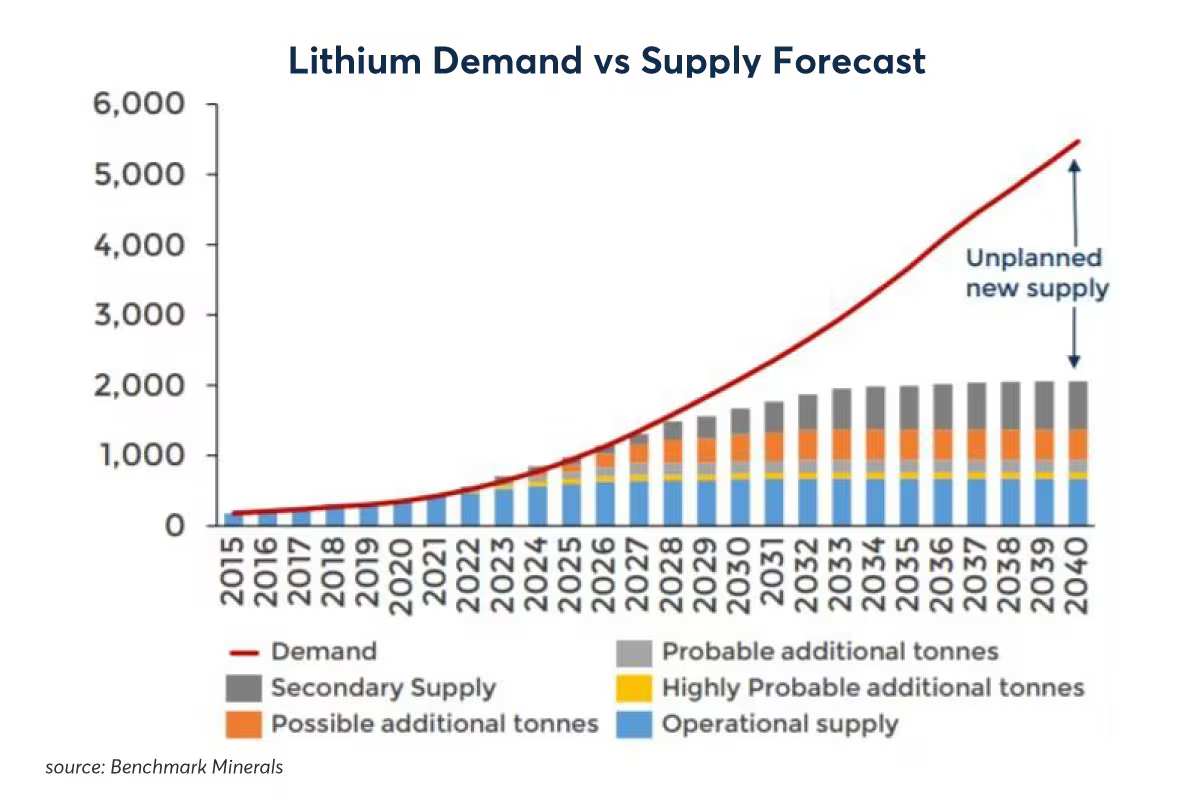
The demand side is also showing a structural explosion. It is no longer just a “one-man show” of electric vehicles, but also AI
Data center energy demand has become a new growth pole. The Guojin Securities Research Report predicts that in 2026, the world will add 438 GWh of new energy storage capacity, an increase of 62% over the previous year. The growth momentum will shift from a single consumption of new energy in the past to a triple drive of “AI computing power infrastructure+energy transition just needed+power grid blockage”. From January to February 2026, China added 9.51 GW/24.18 GWh of energy storage, a sharp increase of 472% over the previous year. Emerging application scenarios such as AI data centers are rapidly rising. It is predicted that global AI data center energy storage lithium battery shipments will exceed 300 GWh by 2030, 20 times the level of 2025.
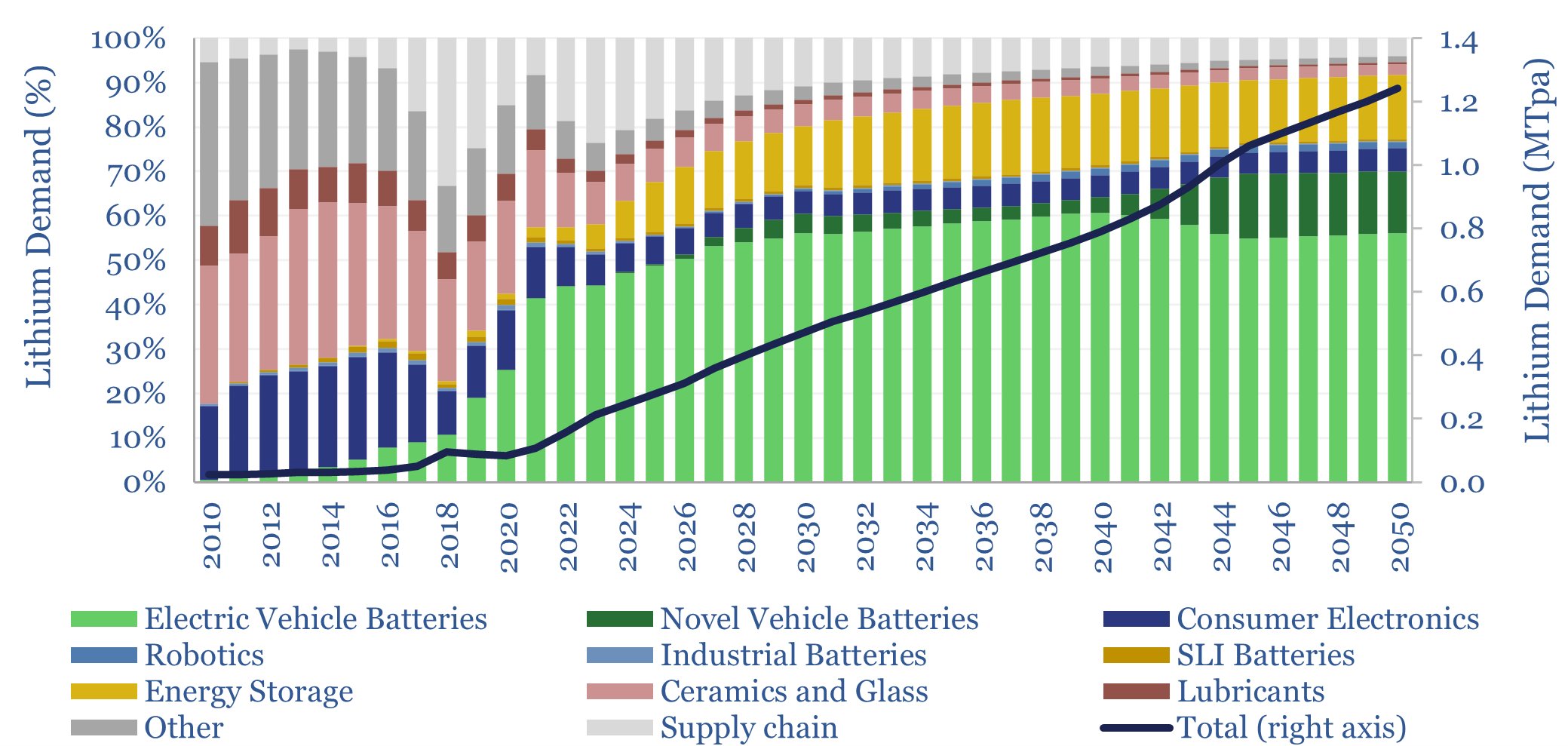
Furthermore, the US-Iran conflict that broke out at the end of February pushed up global oil prices and became an unexpected catalyst for lithium demand. At one point, the price of Brent crude oil soared to 140 US dollars/barrel. The sharp rise in fuel prices has greatly strengthened the cost advantage of electric vehicles over fuel vehicles. According to the Carwow survey, 48% of respondents said they would consider electric vehicles or hybrids as a result, and traffic related to electric vehicles on German car platforms soared 40%. UBS refers to this as the “white oil” effect, pointing out that supply-driven energy shocks have precedents that drive lasting changes in policies, consumer behavior, and industrial strategies.
Internal Digging: Cost Discipline and Financial Remediation Go Hand in Hand
Despite the significant benefits brought by the recovery in lithium prices, Albemarle's management did not relax cost controls. CEO Kent Masters emphasized in a statement: “We focus on what is within control, including operational excellence, cost and productivity control, and cash flow.”
The company achieved $40 million in cost and productivity improvements in the first quarter, and is expected to achieve cost savings of $100 million to $150 million throughout the year. In terms of capital expenditure, the company expects this year to be roughly the same as 2025, about 550 million to 600 million US dollars.
More action has been taken in terms of financial recovery. Albemarle repaid $1.3 billion of debt in the first quarter and lowered the 2026 interest expenditure guidelines to US$120 million to US$140 million, significantly reducing interest costs and improving financial flexibility. The total cash flow from operating activities was US$346 million, and free cash flow was approximately US$248 million, indicating that the company maintained a healthy ability to generate cash while profits rebounded.
Albemarle maintained an overall business outlook based on three lithium price scenarios: under the low price scenario, the company's overall adjusted EBITDA is estimated at 900 million to 1 billion US dollars, while under the high price scenario, it can reach 4.2 billion to 4.4 billion US dollars, providing investors with a clear anchor point for flexible performance expectations.
After years of oversupply and low prices, the lithium industry is entering a new boom cycle. Albemarle itself also closed a large processing plant in Australia in February due to weakening prices. Executives said they would not change their strategy at this time. The company also revealed that lithium production will increase this year, but as customers consume inventory in 2025, sales are expected to remain basically stable — a statement that suggests that Albemarle has chosen a prudent strategy of “price for volume” to prioritize the restoration of profit margins.