


The Zhitong Finance App learned that Google (GOOGL.US) is using its comprehensive layout in the field of artificial intelligence (AI) to launch a strong impact on the position of the company with the highest market capitalization in the world. According to the market view, this giant, which started with search, has quietly evolved into an almost “omnipotent” player in AI competitions.
From “laggards” to “frontrunners”
Investors were still collectively selling off Google less than a year ago — when the market feared that generative AI would disrupt its core search business. However, as Google incorporated AI into search and the Gemini model became a mainstream chatbot, the market narrative fundamentally reversed.
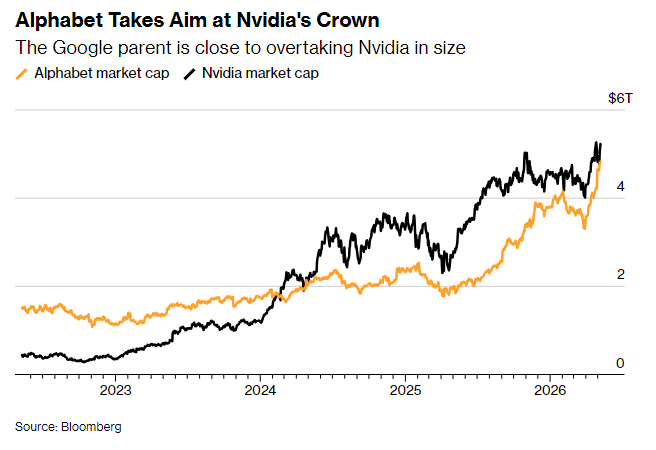
Today, Google's stock price has soared about 160% over the past 12 months, and rose 34% in April alone, the best monthly performance since 2004. As of the end of last week, the company's market capitalization reached $4.8 trillion. Although it still lags behind NVDA.US (NVDA.US)'s $5.2 trillion, the gap has narrowed sharply over the past six months, and was even briefly overtaken during Tuesday's after-hours trading.
Since October 31 of last year, Google's stock price has surged 43%, while Nvidia only rose 6.3% during the same period, underperforming the S&P 500 and Nasdaq 100 indices.
“Has almost the entire AI technology stack”
The core reason investors are willing to generously price Google is that it covers almost all key links in the AI industry chain. Gene Munster, managing partner at Deepwater Asset Management, stated, “Google is one of the two companies with the best layout in the AI field because they have almost the entire technology stack — chips, models, infrastructure, and distribution networks, and more importantly, the company's profit fundamentals are very stable.” In his view, another company in the same tier as Google is SpaceX, a space exploration technology company owned by Elon Musk. The company completed a merger with xAI in February of this year, and the transaction valuation reached 1.75 trillion US dollars.
This judgment accurately sums up Google's unique strengths. As Nvidia takes the lead in the field of AI chips, Google's self-developed tensor processor (TPU) is being favored by more and more customers. Google CEO Sundar Pichai revealed that TPU will soon allow Google Cloud customers to run in their own data centers. Citizens analyst Andrew Boone predicts that TPU related infrastructure businesses will contribute about 3 billion US dollars in revenue to Google in 2026, and soar to 25 billion US dollars by 2027.
Furthermore, Google also owns many huge businesses such as Google Search, Google Cloud, YouTube, and Waymo. Its Gemini AI model is recognized as the top of the industry, and the company is also an important investor in Anthropic, which has another leading model, Claude.
“Google is deeply involved in almost every key area of the AI ecosystem, and with its full business layout advantage, it already has excellent conditions to become the biggest winner in the AI era,” said Luke O'Neill, chief investment officer at CooksonPeirce Wealth Management. “Nvidia is an excellent company, but if AI spending slows down, its performance may be more cyclical. However, Google's business is highly diversified, so even if one business does not perform well, other businesses can make up for it in a timely manner. No company has a wider moat than Google; it's synonymous with the internet age. So it makes perfect sense for it to be the biggest company.”
The latest quarterly earnings report also shows how Google stands out from the big tech companies. Not only did the company exceed expectations in its search and cloud business, but its cloud business backlog of orders almost doubled, reaching US$462 billion. J.P. Morgan has now listed Google as the “first choice” for its technology sector, and Mizuho analysts have also raised its target price, believing that the market's consensus expectations for Google Cloud's revenue and operating profit in the next two years are still significantly low.
Divyaunsh Divatia, research analyst at Janus Henderson Investors, said: “Google has almost everything you want, which is why everyone is so comfortable holding it — because it has so many paths to success in AI. I'm still optimistic about Nvidia; it's still very strong, but it's just a chip maker.”
Don't ignore the “next Oracle” warning
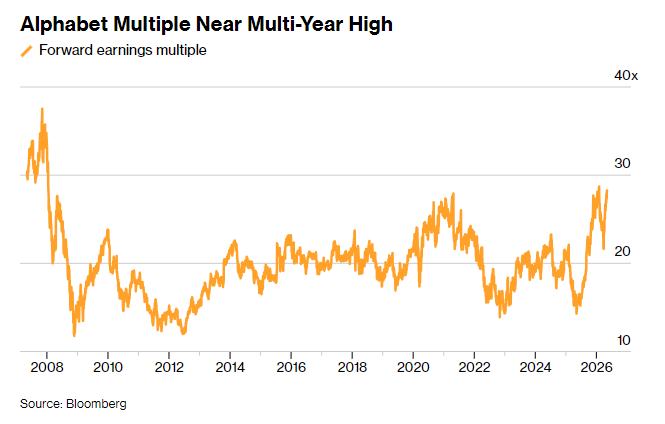
Despite the tremendous rise, Google's current valuation is also soaring. Its stock price is 28 times the estimated profit. Although it is less than the extreme valuation during the internet bubble, it is far higher than the average of less than 21 times in the past 10 years, and close to the highest valuation range since 2008.
However, CooksonPeirce's O'Neill quoted Buffett's famous quote, “Buying a good company at a reasonable price is far better than buying a mediocre company at a low price,” and emphasized that the current price is still reasonable: “Even if we can no longer buy at a very low price, it is not unreasonable to think that this valuation can be maintained or even further increased.” It is worth mentioning that Buffett's Berkshire Hathaway (BRK.A.US) also made a rare investment in Google last year.
But that doesn't mean investing in Google isn't risky. First, Gemini and other top AI models are still likely to be surpassed by competitors. Google's poor stock price performance last year is enough to show how rapidly market sentiment is changing in the AI era.
Second, according to previous reports, Anthropic promised to spend $200 billion on Google Cloud over the next five years to obtain 5 gigawatts of computing power. If you compare that to Google's $462 billion cloud backlog, this customer's commitment alone could account for more than 40% of future contract revenue. D.A. Davidson analyst Gil Luria sounded a wake-up call: “This is the same situation with ORCL.US (ORCL.US).” In September of last year, Oracle's stock price soared due to a 360% surge in backlog orders, but it was later discovered that most of the increase came from a single transaction with OpenAI.
This “AI capital cycle” growth implied vulnerability: Google itself was an important investor in Anthropic, injecting billions of dollars into it, and the latter used that money to buy Google Cloud and TPU in large quantities. If these related transactions are excluded, will real endogenous growth be just as strong? Once Anthropic's huge money-burning model becomes unsustainable, or if it moves to other cloud platforms in the future, what appears to be a solid foundation of growth may be shaken. This means a lot to investors — behind a bright backlog of order numbers, it may be necessary to scrutinize customer concentration and revenue quality more closely.